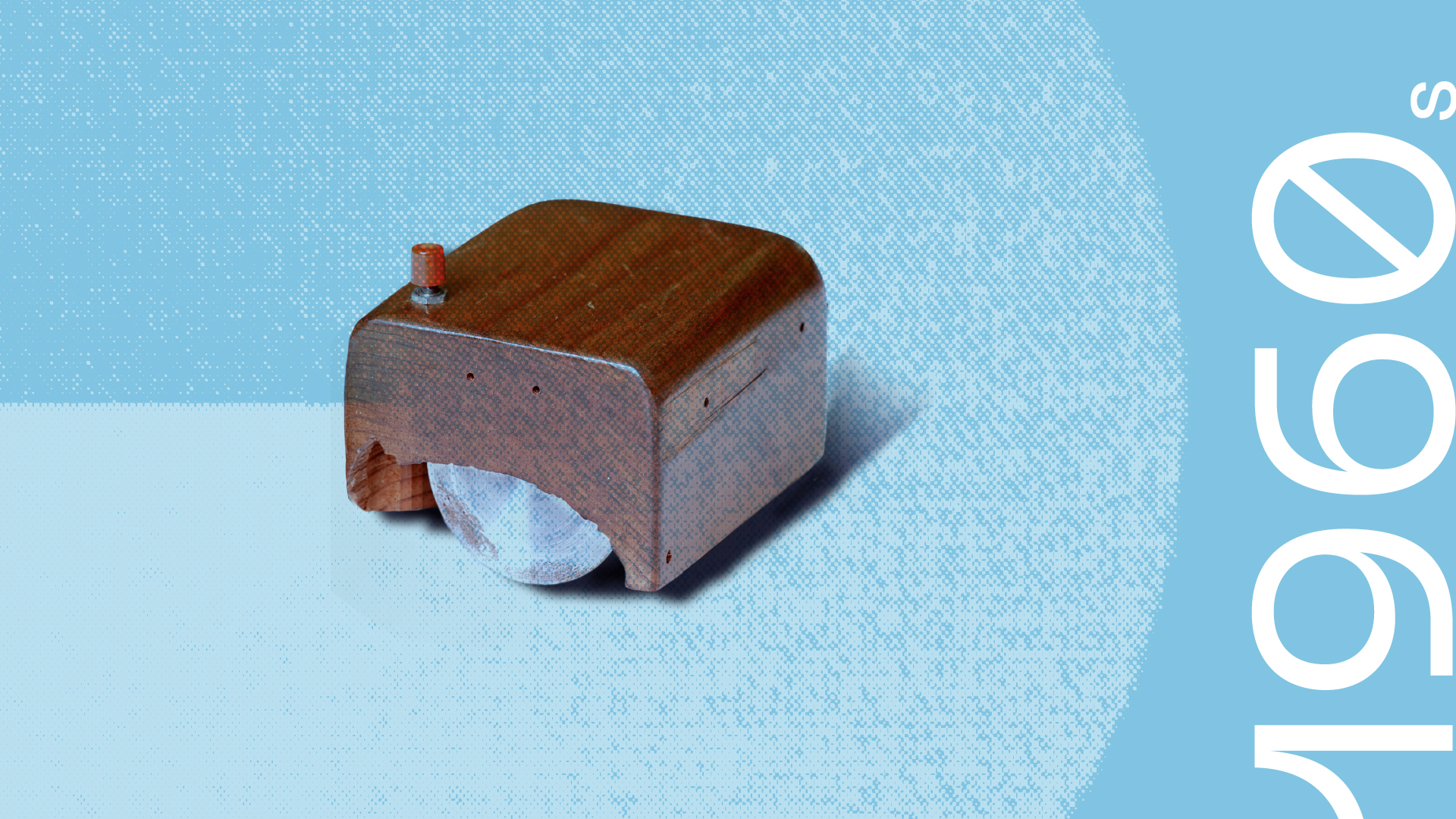
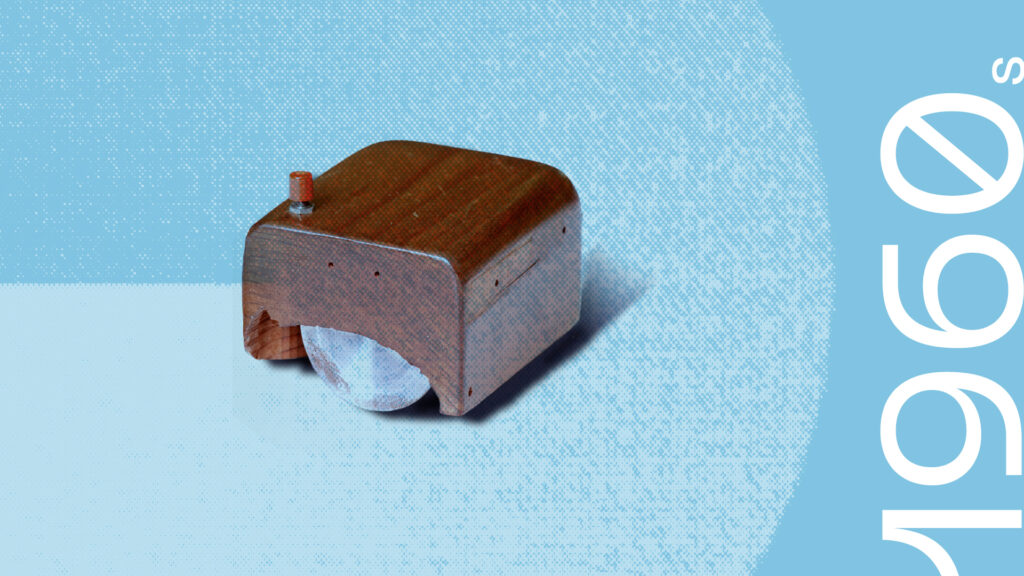
The first computer mouse prototype developed at SRI in 1964.

Development of the mouse began in the early 1960s by SRI International’s Douglas Engelbart, while he was exploring the interactions between humans and computers. Bill English, then the chief engineer at SRI, built the first computer mouse prototype in 1964. Designs with multiple buttons soon followed.
A single wheel or a pair of wheels was used to translate the motion of the mouse into cursor movement on the screen. Engelbart was named the inventor on the basic patent for what was then called the “X-Y Position Indicator for a Display System.” The patent was filed in 1967 and issued in 1970.
The mother of all demos
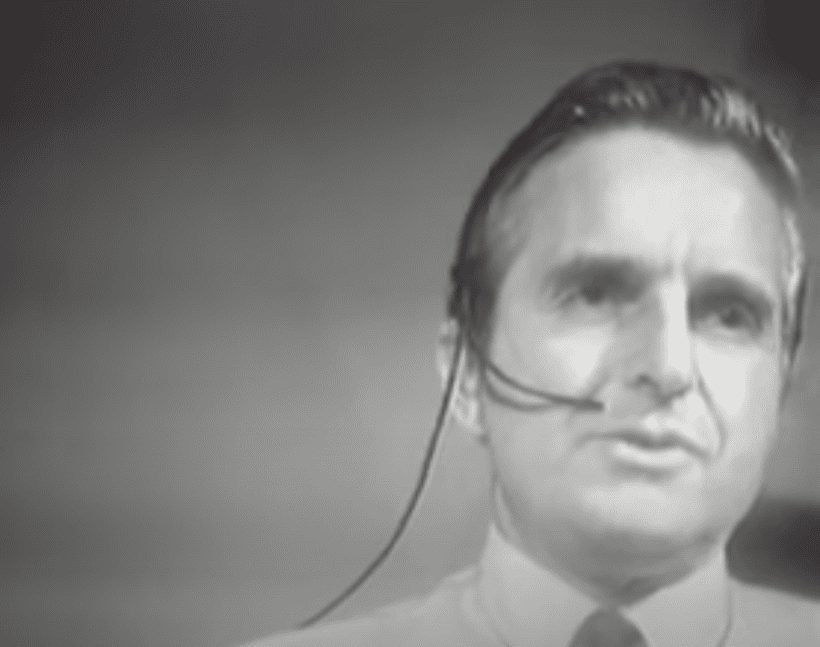
Recognized for its impact on computing and the world, the 1968 event has been dubbed “the mother of all demos“.
For Engelbart, the mouse was one part of a much larger technological system aimed at facilitating organizational learning and global online collaboration. When he was a graduate student in electrical engineering, Engelbart began to imagine ways in which all sorts of information could be displayed on the screens of cathode ray tubes, and he dreamed of “flying” through a variety of information spaces.
In early 1959, Engelbart pursued his visionary ideas by formulating a theoretical framework for the co-evolution of human skills, knowledge, and organizations. At the heart of his vision was the computer as an extension of human communication capabilities and a resource for the augmentation of human intellect.
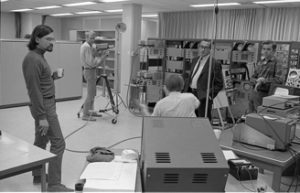
In 1968, Engelbart created and became the director of SRI’s Augmentation Research Center. On December 9, 1968 he staged a 90-minute public multimedia demonstration at the 1968 Fall Joint Computer Conference in San Francisco, with a group of young computer scientists and electrical engineers from the center. It was the world debut of personal and interactive computing, featuring a computer mouse that controlled a networked computer system, which demonstrated:
- Hypertext linking
- Real-time text editing
- Multiple windows with flexible view control
- Cathode display tubes
- Shared-screen teleconferencing
Read our 75th anniversary blog feature
Related innovations