
SRI pioneered minimally invasive telepresence surgery during the 1980s under contract to the U.S. Army. Our novel approach led to the first U.S. FDA-approved telerobotic surgical system.
In 1987, an SRI team led by biomedical engineer Philip S. Green began developing the first surgeon-controlled robotic telepresence surgery system, designed to let surgeons operate on patients from a remote console. The system combined stereoscopic vision, motion scaling, and tremor filtering. The result was a telemanipulator that performed dexterous, minimally invasive procedures with greater precision than the human hand.
In 1995, SRI licensed the technology to Intuitive Surgical, an SRI spin-off, where it became the da Vinci Surgical System. In 2000, da Vinci became the first robotic system cleared by the FDA for general laparoscopic surgery. Today it supports complex operations, including cardiac surgery, through incisions as small as one to two centimeters.
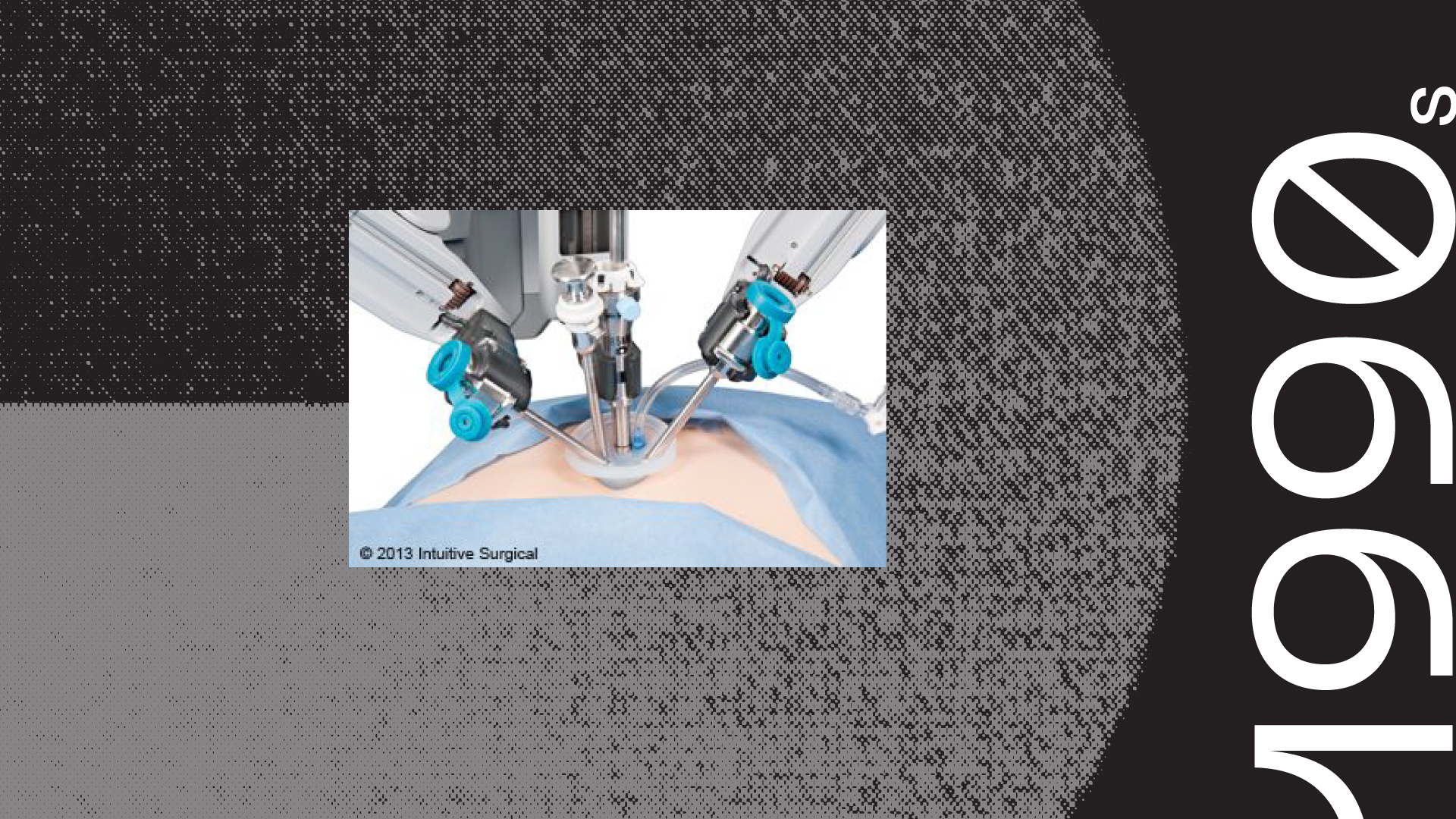
Intuitive Surgical, Inc., created in 1995, licensed SRI’s technology, and its da Vinci system (pictured left) is the market leader in surgical robotics. Throughout the U.S., Europe, and Asia, surgeons use the technology to help patients recover faster, with less pain and fewer complications.