To mitigate the dangers that lasers pose to civilian and military targets, SRI is leveraging photonic circuits to pinpoint the origin points of laser beams.
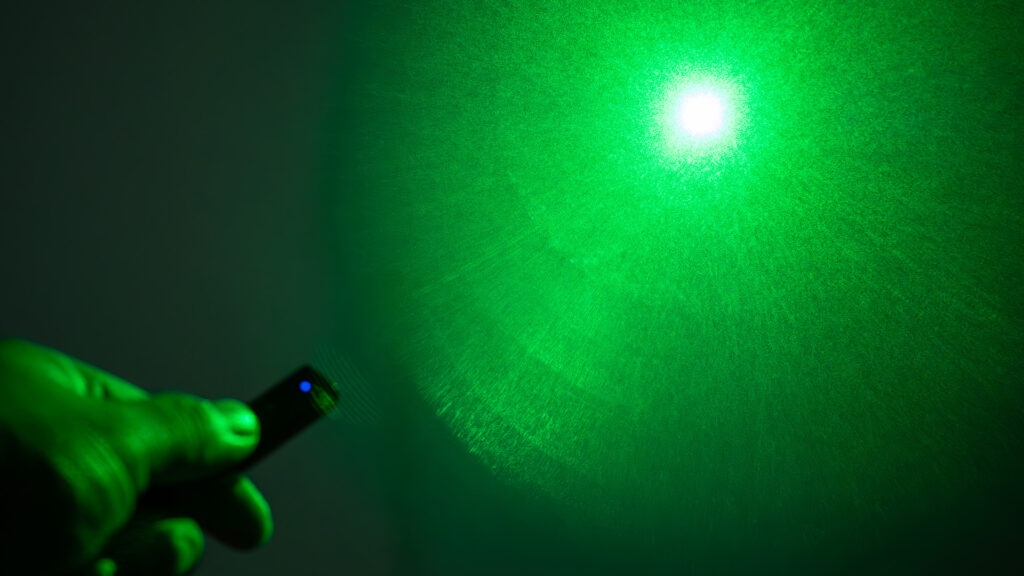
For people who think of laser pointers mostly as a consumer technology used to entertain pets, it might be a surprise to learn that lasers are a growing threat around the world. It’s not just that laser range finders and designators are now ubiquitous in weapons systems fielded by all modern militaries. Laser strikes are also a growing concern in civilian airspace. Aircraft in the Unities States have been subjected to a steady increase in laser pointer strikes in recent years. One recent laser strike targeted Marine One, the helicopter that carries the President of the United States. These strikes, often associated with cheap commercial laser pointers, can disrupt the concentration of pilots and even permanently damage their eyesight, particularly if they are using night vision technology. The FAA documented 10 injuries due to laser strikes in 2025 alone.
The one thing that these military and civilian laser-related threats share: Risk mitigation begins with pinpointing the origin of the laser beam in question. Whether the aim is to give warfighters advance warning of an impending missile strike or to provide law enforcement with actionable information about a laser strike on a commercial airliner, it’s critical to know where the laser is coming from.
From a scientific perspective, building a system that can pinpoint the location of a distant laser emitter is extraordinarily difficult. SRI researchers, however, see great potential to apply photonic circuits to solve this seemingly intractable problem. In addition to providing new capabilities for domestic aircraft operators, this work points toward new approaches to protecting both military and civilian targets from laser-guided weapons.
Why photonic circuits can advance laser detection
Like electronic circuits, photonic circuits can be densely packed with components to efficiently and effectively route photons to transmit information or analyze waveforms.
With funding from DARPA’s Microsystems Technology Office, SRI is developing a new photonic integrated circuit (PIC) that aims to improve our ability to detect and provide vital and timely information about laser-based threats. SRI’s novel method of collecting the angle of incidence information from incident laser beams using a photonic circuit will enable sophisticated analysis and “fingerprinting” of these beams with a tiny, low power system.
“Whether we’re talking about the U.S. Coast Guard or an air ambulance in the U.K., laser pointer strikes can be a reason to abort a life-saving mission.” — Marcus Bagnell
SRI began working on PIC-based laser detection through DARPA MTO’s SOAR (Steerable Optical Aperture Receivers) program. For that program, Cale Gentry (a research scientist in SRI’s Applied Physics Laboratory) led a team that designed a PIC that can accept laser signals within a 30-degree field of view when centered at a wavelength of 1550 nm — a standard wavelength for telecom lasers.
The primary goal of the new effort is to extend the PIC’s field of view from 30 to 120 degrees, greatly increasing its ability to detect incoming beams. This will require redesigning and testing the individual components of the new sensor and also preparing a lab demonstration. “One milliradian of angular resolution is the target,” explains SRI research engineer Marcus Bagnell. “At a distance of ten kilometers, that would tell you where the laser source is to within 10 meters.”
Laser detection for national defense
To architect a PIC-based detector that is applicable to military use cases, this new project will create a PIC composed of silicon nitride rather than silicon. Silicon nitride will extend the PIC’s detection capability into the 1064 nm range (a range associated with the vast majority of military laser range finders and designators), which is not possible with a silicon-based PIC.
In the long term, the SRI team sees great potential to architect these PIC-based capabilities into a fieldable advance warning system. Simply detecting the origin point of an incoming laser range finder could provide a profound advantage to frontline troops. Eventually, the team hopes to go even further, using this PIC-based approach to contribute to a platform that can precisely identify lasers associated with specific military weapons systems (using pulse information and other data). Such a system would provide warfighters (and potentially also civilians in war zones) with life-saving information about impending strikes.
Why laser detection matters for civilians
The challenge that lasers pose to civilian aircraft operators isn’t limited to distraction and potential eye injury. The U.S. Coast Guard flight rules, for example, dictate that an aircraft must abort its mission if a laser strikes the eye of an aircrew member, meaning that lasers strikes can disrupt active emergency response. Yet as laser strikes on domestic aircraft continue to mount, law enforcement has few tools to reverse the tide.
The FAA requests that pilots and crew members immediately report laser strikes, then provides this information to the FBI and other law enforcement agencies. However, because of the inevitable imprecision of a visual estimate, it is virtually impossible for investigators to use this information as the basis for an active investigation, much less find the perpetrators. (In the case of the recent laser strike on Marine One, a suspect was identified thanks to the observations of a U.S. Secret Service agent on the ground, but such opportunities for on-the-ground enforcement are vanishingly rare.) If we could more precisely identify the origin points of these laser strikes using sensors deployed directly on the targeted aircraft, the data could potentially identify patterns, narrow the search area, and perhaps even provide law enforcement with sufficient information to identify specific perpetrators.
“Whether we’re talking about the U.S. Coast Guard or an air ambulance in the U.K., laser pointer strikes can be a reason to abort a life-saving mission,” Bagnell observes. “For that reason alone, we think there will be significant interest in this technology from customers that want to protect aircraft operators from laser-related threats.”
Learn more about SRI’s deep contributions to defense and security.
Distribution Statement A: Approved for public release, distribution unlimited. This research was, in part, funded by the U.S. Government. The views and conclusions contained in this document are those of the authors and should not be interpreted as representing the official policies, either expressed or implied, of the U.S. Government.