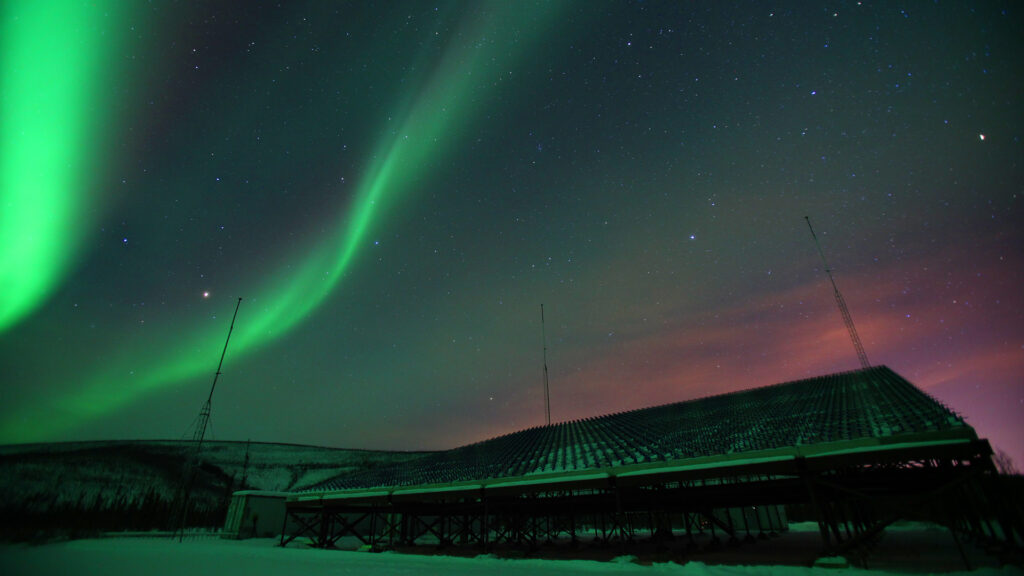
By providing data from the SRI-operated Poker Flat Incoherent Scatter Radar, SRI scientists are helping NASA better understand the electrical currents in ionospheric plasma.
The aurora borealis is more than just a visual spectacle. The northern lights phenomenon (and its counterpart at the South Pole) is amplified by geomagnetic storms, which can disrupt high frequency radio, satellite communications, and even power grids.
For decades, NASA has been steadily advancing our understanding of space weather and its implications for life on earth. This month, an SRI-supported NASA mission named GNEISS sent two rockets into the upper atmosphere to collect new data about the electrical currents that cause polar skies to glow.
“It’s essentially like doing a CT scan of the plasma beneath the aurora,” explained Kristina Lynch, principal investigator for GNEISS and a professor at Dartmouth College, in the NASA press release announcing the February 10 launch.
“SRI’s AMISR program has a long history of supporting NASA sounding rocket missions, and we can’t wait to see how data from this mission will elevate our understanding of the physics behind these complex electromagnetic events.” — Asti Bhatt
To support the launch, SRI provided critical contextual data from the Poker Flat Incoherent Scatter Radar. Designed, constructed, and operated by SRI, this radar array — created as part of SRI’s larger work on Advanced Modular Incoherent Scatter Radar (AMISR) supported by the U.S. National Science Foundation — provided measurements of the geophysical region around the rocket flight paths both before and after the launch. By combining the AMISR measurements of fast plasma velocities during the aurora with in-situ measurements from the rockets themselves, scientists will gain a new perspective on geomagnetic storm-time dynamics.
“AMISR is a class of radars that provides uniquely accurate, three-dimensional measurements of fundamental ionospheric plasma parameters,” says Asti Bhatt, a research engineer at SRI and the principal investigator for SRI’s PFISR work. “SRI’s AMISR program has a long history of supporting NASA sounding rocket missions, and we can’t wait to see how data from this mission will elevate our understanding of the physics behind these complex electromagnetic events.”
In addition to supporting NASA missions, SRI’s AMISR technology is a critical component of LeoLabs, an SRI spinout that provides persistent orbital intelligence to ensure the safety of government and commercial space missions.
Learn more about how SRI has contributed to the safety and success of space missions since the dawn of the Space Age.
This material is based upon work supported by NASA under award No. 80NSSC24M0028 and by the U.S. National Science Foundation under Cooperative Agreement No. AGS-1840962. Any opinions, findings and conclusions or recommendations expressed in this material are those of the author(s) and do not necessarily reflect the views of the U.S. National Science Foundation or NASA.