Author: SRI International
-
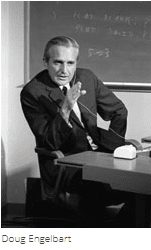
1968 “Mother of All Demos” Forecasted Much of the Technology We Use Every Day
We all have our share of anniversaries to remember, but here’s one that has impacted all of our lives: on December 9, 1968, Douglas Engelbart and his SRI team delivered what has come to be known as the “Mother of All Demos.” Hard to believe, but in one presentation, Dr. Engelbart and his Augmentation Research…
-
The DRD4 Exon III VNTR, Bupropion, and Associations with Prospective Abstinence
We used univariate, multivariate, and longitudinal logistic regression to evaluate effects on point prevalence and continuous abstinence at end of treatment in European ancestry participants in a trial randomizing participants to active or placebo bupropion.
-
Replaying the Fracture Process of a Failed Space Shuttle Orbiter Thruster
The work shows how a failure event can be replayed through fracture surface topography analysis, FRASTA, and how information on load conditions, relative crack growth rates, and fracture mechanics parameters may be extracted from fracture surfaces.
-
Mathematics Teaching Practices with Technology That Support Conceptual Understanding for Latino/a Students
We analyze how three seventh grade mathematics teachers from a majority Latino/a, linguistically diverse region of Texas taught the same lesson.
-
Gender-Stratified Gene and Gene-Treatment Interactions in Smoking Cessation
We conducted gender-stratified analyses on a systems-based candidate gene study of regions involved in nicotinic response and the brain—reward pathway in two randomized clinical trials of smoking cessation treatments (placebo, bupropion, transdermal and nasal spray nicotine replacement therapy).
-
Catalytic Detoxification of Nerve Agent and Pesticide Organophosphates by Butyrylcholinesterase Assisted with Non-Pyridinium Oximes
In the present paper we show a comprehensive study on hydrolytic detoxification of nerve agent and pesticide OPs catalysed by purified hBChE in combination with novel non-pyridinium oxime reactivators.
-
Latent Profiles of Problem Behavior within Learning, Peer, and Teacher Contexts: Identifying Subgroups of Children at Academic Risk across the Preschool Year
Employing a developmental and ecological model, the study identified initial levels and rates of change in academic skills for subgroups of preschool children exhibiting problem behavior within routine classroom situations.
-
Targeting Glioblastoma Stem Cells: Cell Surface Markers
In this review, we primarily summarize recent advances in identification of GSC markers, with a particular focus on cell surface markers.
-
Two-dimensional deformation potential model of mobility in small molecule organic semiconductors: DNTT-C10 and BTBT-C12
The high mobility measured in alkylated DNTT and BTBT molecules [1,2] raises the possibility that band transport may be achievable in solution processed organic semiconductors.
-
Handheld flow cytometer for rapid pathogen characterization in water
In order to achieve more timely assessment of water quality, PARC is developing a compact and robust platform for rapid pathogen characterization in water.
-

Finding the Links between College-Level STEM Participation and Autism Spectrum Disorder
There’s a common perception that people with Autism Spectrum Disorders (ASDs) are more likely than the general population to gravitate toward science, technology, engineering, and mathematics (STEM) fields. It turns out the perception is true. Our study results, published online in the November 1 issue of Journal of Autism and Developmental Disorders, confirmed for the first…
-
Closing the Gap between Science Students and STEM Workers of the Future
Many of today’s high-wage jobs and fastest growing occupations require science, technology, engineering, and math (STEM) skills. There is general agreement that strengthening STEM teaching and learning is key to workforce readiness and growth of the U.S. economy. Tomorrow’s thinkers will need STEM skills to develop innovative solutions to the world’s increasingly complex problems. Yet,…