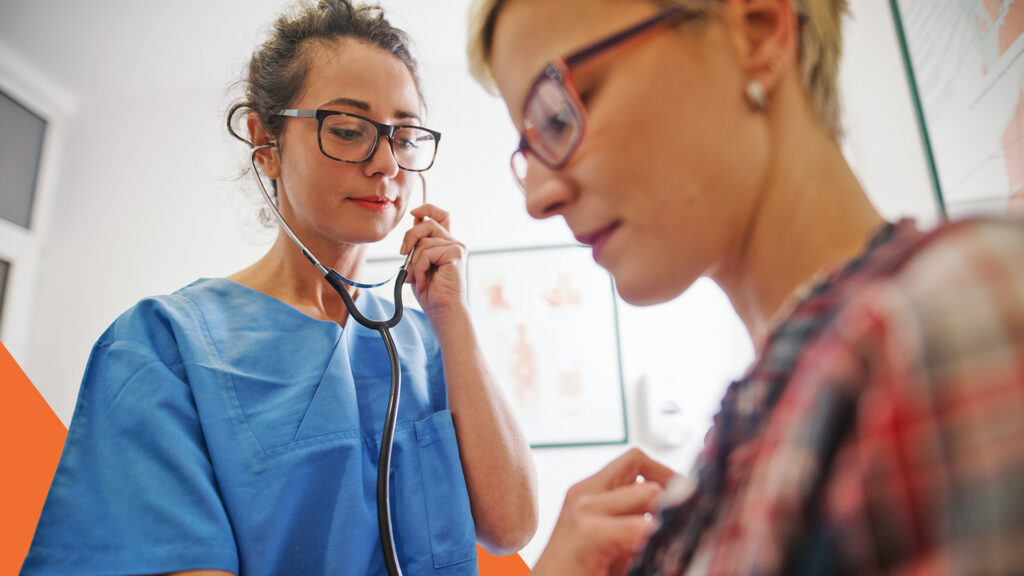
With support from the Advanced Research Projects Agency for Health (ARPA-H), SRI researchers are building an AI-driven system designed to upskill clinicians and transform rural healthcare delivery.
For the past fifteen months, SRI has been working with the Advanced Research Projects Agency for Health (ARPA-H), an agency under the U.S. Department of Health and Human Services, to execute a bold vision for next-generation mobile healthcare.
Rural healthcare options around the country are becoming more limited as hospitals and other care facilities close and consolidate. ARPA-H’s Platform Accelerating Rural Access to Distributed and Integrated Medical Care (PARADIGM) program seeks to develop a technology-driven mobile platform that can deliver advanced hospital-level care to every rural county in America.
SRI researchers, working in collaboration with partners including Mayo Clinic and the University of Florida, are building an intelligent task guidance system for that platform. This software is designed to upskill healthcare workers in real time, enabling them to safely, accurately, and confidently carry out clinical procedures typically performed by specialists. Recent user testing using clinical simulations indicates that SRI’s approach is solving some key problems that have hampered past efforts at next-generation medical task guidance.
A system that guides, monitors, and responds
This past year, the SRI research team has focused on building a task guidance system to direct users through a blood draw procedure. SRI’s system integrates multimodal AI — including real-time computer vision, speech understanding, and procedural reasoning — to guide, monitor, and adapt to user actions.
“This work … speaks to SRI’s unique ability to translate advanced AI capabilities into practical systems that improve clinical performance, enhance patient safety, and deliver real-world impact.” — Jason Tyan
The system uses an overhead camera and a tablet-based interface to track each step of the procedure, confirm correct actions, flag errors, and tell the user what to do next. Much like in-person training with a specialist, it can provide what Tyan calls “reactive guidance,” allowing a healthcare worker to ask questions during the procedure, and “proactive guidance,” in which the system monitors performance and intervenes when needed.
“This work is possible because SRI brings together the combined expertise of multiple world-class technical labs,” says SRI program director Jason Tyan, the principal investigator for SRI’s task guidance work. “It speaks to SRI’s unique ability to translate advanced AI capabilities into practical systems that improve clinical performance, enhance patient safety, and deliver real-world impact.”
Strong user satisfaction — and performance beyond target
The most striking year-one result may be usability. According to Tyan, the program’s initial target was 50% user satisfaction. SRI’s team far exceeded that benchmark. Based on the System Usability Scale (SUS), the system achieved an “A” grade, corresponding to a score of 85 and an estimated user satisfaction level of about 95%.
The users in this simulated phlebotomy (blood draw) procedure were medically trained participants — including physicians, medical students, nurses, and clinical practitioners — but not specialists who routinely perform phlebotomy. That made the test especially relevant to PARADIGM’s goals. Like the anticipated future users of the PARADIGM platform, these were people with clinical background knowledge, but not deep procedural repetition in that specific task.
“We’re seeing clear evidence that, if you use our system, the procedure becomes more accurate and is more likely to be successful.” — Jason Tyan
“Clinicians immediately recognized the upskilling potential here,” Tyan says. “Even though they weren’t experienced phlebotomists, they were surprised by how seamlessly and confidently they were able to execute a simulated blood draw.” He adds that users responded strongly partly because the guidance helped them remember next steps and get answers in real time when questions arose.
The performance data were also promising. In one proficiency evaluation, participants using SRI’s system achieved 97% accuracy in completing the simulated procedure. By contrast, a comparison group without access to SRI’s AI-driven guidance system performed at substantially lower accuracy, around 65%.
“We’re seeing clear evidence that, if you use our system, the procedure becomes more accurate and is more likely to be successful,” Tyan emphasizes.
Looking ahead: scalable, adaptive clinical intelligence
As the work moves into year two, SRI is expanding the system to support additional procedures while enhancing scalability and generalizability. A key focus is enabling rapid adaptation to new tasks with minimal additional training data, a key challenge for any human-machine guidance system. The opportunity is larger than a single demo or metric. If ARPA-H’s PARADIGM program succeeds, mobile platforms will bring advanced care closer to the communities that need it most. SRI’s task guidance system could enable any qualified healthcare worker to deliver specialist-level care, anywhere, anytime, through intelligent, real-time guidance.
“This is a unique opportunity to redefine how clinical expertise is delivered,” Tyan concludes. “Our goal is to bring specialist-level care directly to the point of need, supported by intelligent systems that empower healthcare workers and improve patient outcomes.”
Learn more about how SRI is advancing human health and responsible AI.
This research was funded, in part, by the U.S. Government. The views and conclusions contained in this document are those of the authors and should not be interpreted as representing the official policies, either expressed or implied, of the U.S. Government.