
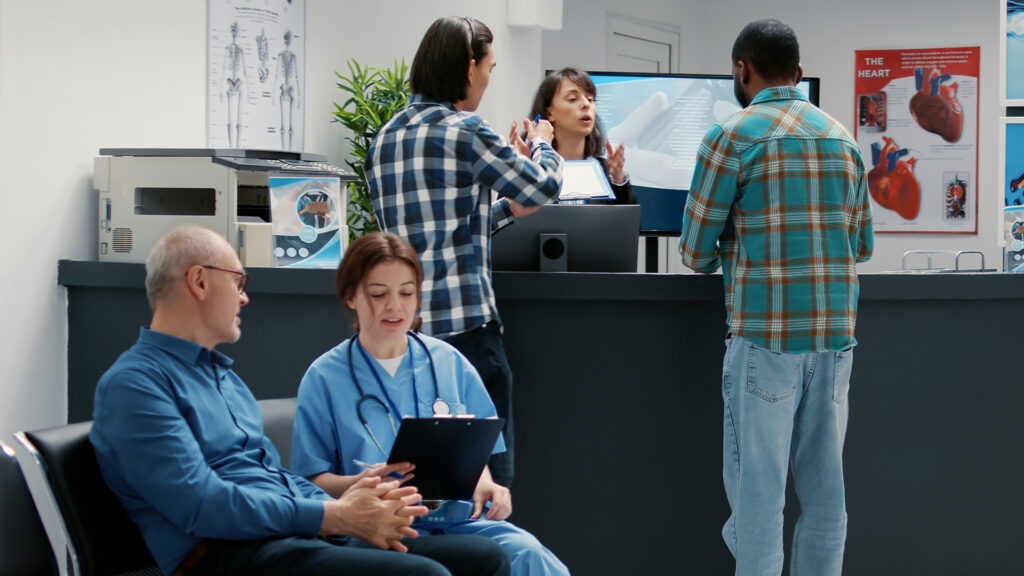
Helping systems talk to each other increases patient safety, lowers costs, reduces errors, and streamlines treatment.
When a patient visits a new specialist or transfers to a different hospital, their medical history should follow them seamlessly. Instead, critical information often gets lost in translation between incompatible systems, forcing providers to make decisions with incomplete data. This fragmentation leads to medication errors, duplicated tests, delayed diagnoses, and preventable complications. As healthcare grows increasingly complex, with patients seeing multiple specialists and moving between facilities, the inability of systems to communicate reliably is inefficient and can be dangerous.
SRI is tackling this challenge with platforms that ensure healthcare data moves safely and accurately wherever patients need care.
SRI’s ARPA-H-funded FHIR-Fly and Parsemony platforms aim to improve dependability and interoperability across complex healthcare systems. These technology platforms are part of ARPA-H’s DIGIHEALS (Digital Health Security) program and have been developed to ensure the integrity of health data while enabling seamless incorporation of clinical facts derived from natural language.
“The technology includes sophisticated, automatic flagging capabilities to maintain data integrity throughout the translation process.” — Linda Briesemeister
FHIR-Fly, an open-source software platform, automatically translates between disparate healthcare data formats, addressing one of the most persistent barriers to effective care. By enabling interoperability, FHIR-Fly is built to ensure that critical patient information can be understood securely and automatically between systems, providers, and institutions. This advancement aims to help healthcare professionals make informed decisions by integrating previously disparate and siloed patient information.
“Healthcare systems struggle with incompatible formats that prohibit the exchange of vital patient information,” says Linda Briesemeister, principal computer scientist in SRI’s Information and Computing Sciences division. “SRI is solving this with a lens on trust, security, and privacy. The technology includes sophisticated, automatic flagging capabilities to maintain data integrity throughout the translation process.”
SRI’s Parsemony harnesses the power of LLMs to transform natural language text into structured, machine-readable formats, enabling healthcare providers to use clinical information efficiently and reduce administrative burdens.
These platforms can improve data management across healthcare organizations, providing effective, affordable, and scalable solutions. To improve patient medication adherence, for example, the platforms can offer recommendations based on machine-readable information extracted from clinical practice guidelines, FDA labels, and user preferences.
“Building information infrastructures that providers, patients, and institutions can rely on is critical in human-to-machine systems,” says Briesemeister. “SRI’s platforms aim to make them secure so that information is communicated reliably, privately, and objectively across settings.”
To learn more or to explore collaborating with SRI, contact us today.
This material is based upon work supported by the Defense Logistics Agency (DLA) and the Advanced Research Projects Agency for Health (ARPA-H) under Contract Number SP4701-23-C-0073. Any opinions, findings and conclusions or recommendations expressed in this material are those of the author(s) and do not necessarily reflect the views of DLA or ARPA-H.