SRI’s Education Division president seeks to provide students, educators, and policymakers with the tools to manage a transformative period in education.
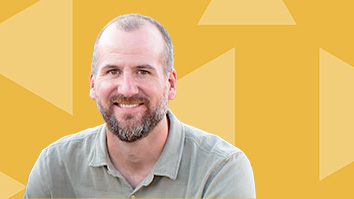
Earlier this month, Todd Grindal was named president of SRI’s Education Division. Grindal joined SRI in 2017 and holds an Ed.D. from Harvard Graduate School of Education. He has published extensively on inclusive education, early learning outcomes, digital media, and systems-level policy interventions. He recently served as a Lecturer at Harvard Graduate School of Education and sits on the Professional Advisory Board of the National Center for Learning Disabilities.
Here, he explores his own career path; discusses the future of education research in the age of AI; and demonstrates how SRI brings rigor, relevance, and insight to its education work.
SRI has been doing education research for more than 50 years. How do you sum up that legacy for people?
I often start with the work that we did in the 1980s and 1990s focused on the experiences of students with disabilities.
There was law passed in the mid-1970s that gave all kids with disabilities the right to go to public school. A decade later, we wanted some real data to understand how that was working. How did the outcomes differ from state to state, from district to district, between kids of different races and ethnicities, between rich kids and poor kids? Were there different outcomes for kids with different kinds of disabilities?
SRI took on the challenging task of doing that research.
It was valuable not just because of what it told us about the experiences of students with disabilities — about what worked well and what didn’t, and how opportunities were being allocated or withheld. That series of studies also helped to make the argument that evidence helps us teach better. Those studies were part of the argument, in the early 2000s, to say: “We’re going to build a system that helps us get evidence defined by rigor and focused on relevance.”
I wasn’t part of SRI at the time, but I take a lot of pride in that part of our legacy.
You were a teacher before you became interested in education research. What drew you toward the field of education in the first place?
People become teachers, generally, for one of two reasons. Either they loved school and they never wanted to leave, or they hated school. It was awful for them and they had to make it better.
I was very much the latter. I had a tough time in school. I’m dyslexic. In 2025, it’s not a big hassle for me. I have screen readers that can read things to me and spell checks that catch errors in my writing. With all of these more recent accommodations, I can do my work in a very text heavy field just the same as anybody else.
“I realized: I don’t want to be a lawyer. I really like what I’m doing. I really like that feeling of: I see you, kid. I know that experience you’re having. And I think I can do this a little differently. I think I can help.” — Todd Grindal
But as an elementary school student in the late 70s and early 80s, it was really hard. Like a lot of dyslexic kids, I could not read anywhere near on par with my peers as I started middle school.
I was very fortunate. Looking back, that has a lot to do with the privileges I enjoyed, for example, coming from a family that was well-connected within my community. I’m also able to look back and see how I was able to find educational institutions that didn’t quite fit the mold. I went to a performance arts magnet school. I went to a non-traditional university, New College of Florida. The standards were high, but they were determined in collaboration with faculty. So I could demonstrate what I knew by sitting down and talking with a faculty member.
I did not finish my undergraduate intending to become a teacher. I was planning to go to law school. But a friend of mine left his job as a tutor in an after-school program and I took his job. That turned into a job as a substitute teacher. And I realized: I don’t want to be a lawyer. I really like what I’m doing. I really like that feeling of: I see you, kid. I know that experience you’re having. And I think I can do this a little differently. I think I can help.
How did you move from teaching to education research?
I felt that the quality of my teaching reached a point where I needed additional perspective. I went to graduate school to be a better teacher, and I was quite surprised by how much I enjoyed the research process and how I kept having more questions. “Why is it that way? Couldn’t we do that better? Why is this state doing so much better than that other state?” I had always intended on returning to teaching. And I did go back to teaching for a year.
But I had that bug, right? I had all these questions. I wanted to spend some more time trying to understand: “Why does this work this way? And how do we make it better?”
What eventually brought you to SRI?
When I was a graduate student, our professor invited Mary Wagner — an SRI education researcher who unfortunately passed away recently — to speak to our class. Mary and her team had just published a major report. I read the study and was so impressed by the quality of what she and her team had done. I was struck by how directly the research was speaking to the needs of state education leaders, school district leaders, and teachers.
I saw relevance. I saw impact. So SRI was on my radar as a place that combined rigor and relevance.
“I was struck by how directly [SRI’s] research was speaking to the needs of state education leaders, school district leaders, and teachers. I saw relevance. I saw impact.” — Todd Grindal
Later, I was able to observe my predecessor in this job, Shari Golan. We all work together across these education research institutes. We see each other at conferences. And what I saw in Shari was an approach that was supportive and collaborative. I could see how she got the best out of her team. I thought: I want to be part of an environment and a culture that works that way.
Finally, I saw that SRI offered something that nobody else in education research even comes close to — the connection to new technologies. At SRI, we have access to deep domain experts who are thinking about advanced technology applications in all sorts of industry contexts. So we can start thinking about: How could we take what they’re doing and apply it to problems that seem impossible for us in education?
Some of the biggest questions in education right now involve AI. How is SRI Education navigating that?
Powerful generative AI tools that have been around for a couple of years are quickly finding their way into the hands of teachers and students. That is exciting, but it hasn’t yet been determined whether this is going to be a net positive or a net negative for learning.
I’ve experienced this personally. My first year teaching graduate students happened to be the first year after ChatGPT came out. The sense at the time was: No AI. You may not use it. That’s cheating. The second year was: Well, maybe there are some allowable uses of AI, but it’s very narrow. As I got into teaching the course in 2024, I started asking the students: How are you using these tools and why? Instead of saying that we’re not going to use these tools, it forced me to redesign my curriculum, my teaching, and even my goals as a teacher. It was hard. I still don’t know if I got it right. But it was exciting.
“We have a massive opportunity to better understand, based on evidence, what AI developers need to know about AI in education.” — Todd Grindal
At SRI, we’re having conversations with experts who are thinking about this from pre-K all the way to post-secondary. On the tech side, we’re regularly talking with the people who are developing new AI capabilities both inside and outside of SRI. We have a massive opportunity to better understand, based on evidence, what AI developers need to know about AI in education.
Could you describe a recent project or two that exemplifies the value that SRI Education brings to education systems?
For seven years we have been working with Arkansas’s Department of Education. The state of Arkansas makes preschool available to all foster kids. They know how important it is for kids to go to preschool, especially for those who are experiencing trauma. Yet many foster kids were not going to preschool, and they wanted to know why.
We spent a lot of time in Arkansas. We worked with others who were deeply embedded in this system. There wasn’t a single answer. But we were able to work with the state to come up with solutions that were consistent with the best research and with needs of those children.
We learned that foster parents were often unaware of the services already available to help them find care and programs (like Head Start) that were eager to serve foster children. We also learned that the faith community was a critical support to foster families in the state, yet there were minor issues that were preventing faith-based childcare programs from serving foster children. We pointed out ways to smooth the path for faith-based providers.
I’m also really excited about the work we have been doing focused on what children are watching on YouTube. We did not set out to do a study on YouTube, but as we pulled the data on one of our studies about six years ago, we saw that children were spending a surprising amount of time on the platform. SRI enabled us to take internal research funds and say: This is this is an emerging issue. We need to figure out what’s going on here. Under the leadership of Claire Christensen, we’ve been able to better understand what young children watching on YouTube and ask: Is this problematic? Is this educational? How might the pacing of content affect how children experience digital video? Based on that research, we can also start developing tools that can give parents some opportunities to guide children on YouTube. That’s the kind of forward-thinking work that we’re able to do here that I think you can’t do anyplace else.
How do you encapsulate your vision for SRI Education at this moment in time?
It’s an exciting time in the field of education and at SRI. We have the unique ability to bridge the gap between research and real-world impact. I am thrilled to be able to take the lead at this time with an eye on collaboration, SRI’s technology expertise, and our commitment to delivering rigor and relevance.
As experts across the ecosystem work to navigate education’s most complex challenges — particularly how AI will transform teaching and learning — what sets SRI apart is our unparalleled access to cutting-edge technology development. SRI’s team can envision educational research and solutions that would be impossible elsewhere.
Learn more about SRI’s Education Division or contact us.