
An NSF-funded initiative led by SRI is producing standards-aligned, developmentally appropriate assessments and teacher supports for first-grade science.
Led by SRI researchers and funded by the National Science Foundation (NSF), the Science Assessments for Language Diversity in Early Elementary Classrooms (SALDEE) initiative is producing a suite of standards-aligned formative assessment tasks and instructional supports for first-grade science classrooms, with a focus on students who have developing language skills and diverse linguistic capacities.
The project creates assessment materials that help teachers elicit, interpret, and respond to young students’ science thinking in developmentally appropriate ways, engaging students in three-dimensional science learning while allowing them to communicate through talking, drawing, writing, and interacting with classroom materials.
SALDEE is also producing classroom-ready tasks, rubrics, and teacher administration guides that support early science instruction and address the need for practical NGSS-aligned assessments for young learners.
The project offers a rigorously designed and tested model for developing formative assessments that attend to science learning, language development, and classroom implementation, contributing usable tools for teachers and a broader framework for future assessment and curriculum design.
Supporting science learning in early grades
There is a pressing need for high-quality, classroom-based formative assessment tasks in the early elementary grades that are aligned with the NGSS. This need is especially important in first-grade science, where students are still developing language and literacy skills and may not yet be able to show what they know through traditional written responses. Early elementary science is also often under-supported compared with literacy and mathematics, leaving teachers with fewer usable tools for understanding students’ science thinking.
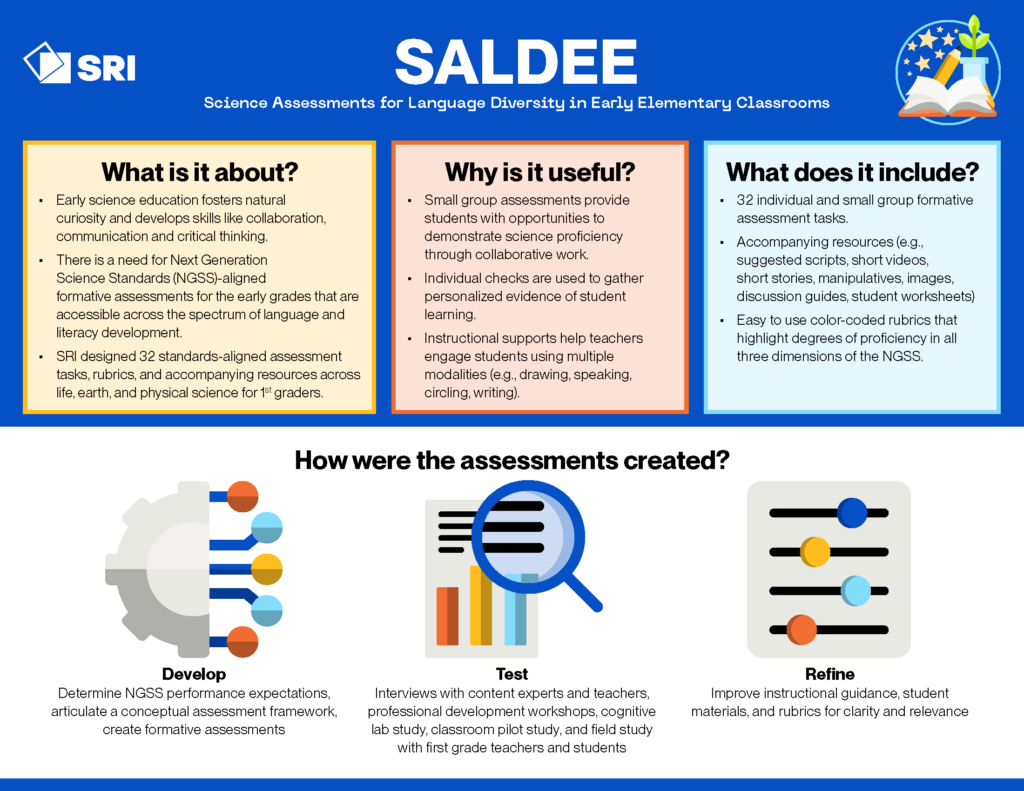
SALDEE addresses this gap by developing formative assessment resources that are developmentally appropriate, instructionally useful, and responsive to the diverse ways young learners communicate their ideas.
SALDEE is an NSF-funded project (NSF 2201051) that is producing a suite of NGSS-aligned formative assessment tasks for first-grade science, along with rubrics and teacher administration guides that help teachers administer the tasks, interpret student responses, and use the results to inform instruction.
The tasks are designed to engage students in three-dimensional science learning, including disciplinary core ideas, science and engineering practices, and crosscutting concepts.
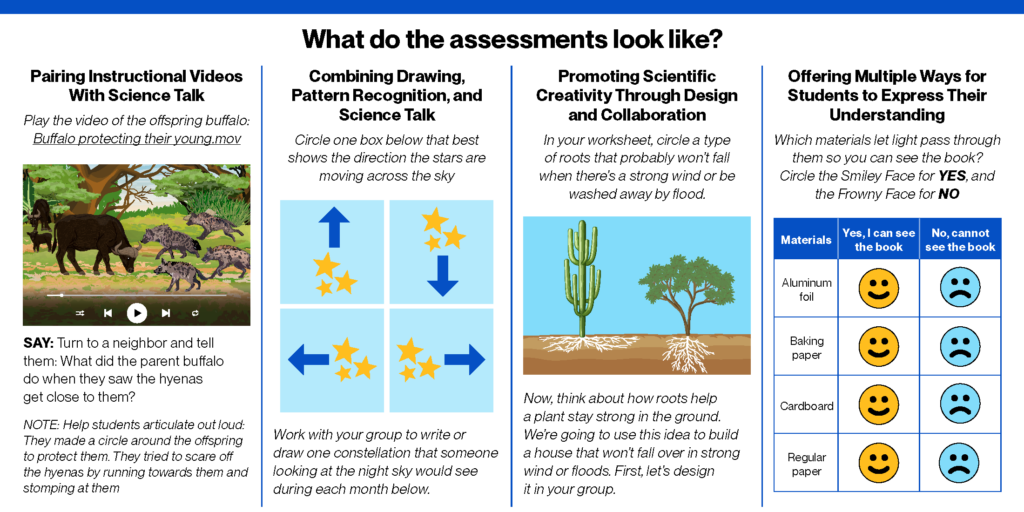
They also allow students to demonstrate their understanding through multiple modes, including talking, drawing, writing, and interacting with classroom materials. This multimodal design is essential for young learners because it reduces the likelihood that developing reading or writing skills will prevent students from showing their science understanding.
The project uses an evidence-centered design approach to ensure that the assessments are coherent, systematic, and grounded in a clear validity argument. This approach connects what the project wants to know about student learning, what evidence students can provide, and what kinds of tasks will elicit that evidence. As a result, SALDEE is not only creating individual assessment tasks, but also building a rigorous model for how early elementary science assessments can be designed, tested, revised, and used in classrooms. This model can support future assessment developers, curriculum designers, and researchers who are working to create NGSS-aligned materials for young students.
SALDEE’s resources include teacher-tested, classroom-ready assessment tasks; color-coded rubrics that describe varying levels of proficiency across the three dimensions of the NGSS; and support materials that help teachers implement the tasks in realistic classroom settings.
These materials are intended to be practical and usable for teachers, not just technically aligned to standards. Findings from SALDEE’s pilot and field work suggest that teachers value the tasks, particularly because they provide structured opportunities for students to engage with science concepts and show their thinking in different ways.
Contributing to the field
To build evidence of validity and usability, SALDEE is gathering data from multiple sources, including expert review, student cognitive interviews, classroom pilots, teacher feedback, student responses, observations, and a field study. The project is using both qualitative methods and psychometric analyses to examine whether the tasks elicit meaningful evidence of science understanding, whether scoring categories function as intended, and whether the assessments are usable across classroom contexts.
This work is important because it strengthens the field’s capacity to assess early science learning in ways that are fair, instructionally meaningful, and responsive to young children’s developmental needs. SALDEE provides teachers with tools they can use to better understand and support student thinking, while also contributing a design framework that can inform future science assessment and curriculum development. In doing so, the project supports teachers and students access to high-quality science learning in the early grades and helps make young students’ science ideas more visible.
Publications and resources
Associated fields of research
Associated SRI team members
-

Nonye M. Alozie
Deputy Director of STEM & CS Program Team/ Principal Education Researcher, SRI Education
-

Sara Gracely
Project Manager, SRI Education
-

Hui Yang
STEM & CS Researcher, SRI Education
-

Arif Rachmatullah
Education Researcher, SRI Education
-

Marta Mielicki
Education Researcher, SRI Education
-

Anna Jennerjohn
Senior Education Researcher, SRI Education
-

Douglas J. Gagnon
Principal Education Researcher, SRI Education
-

Satabdi Basu
Principal Education Researcher, SRI Education


