By synthesizing carbon-absorbing aerogels in microgravity, SRI research will give us a rare glimpse into how these materials could be radically improved.
For years, SRI has been developing a class of aerogels — ultra-light, sponge-like materials with tiny pores — that can capture carbon dioxide directly from the air. Carbon capture is a critical technology amid rising global temperatures. But there’s still much to learn about how to further optimize and commercialize promising carbon capture aerogels.
To chart the future of these aerogel materials, SRI is sending them into space.
“Opportunities to run experiments on the International Space Station are incredibly rare and coveted in the scientific community. It’s an honor to have our research selected for this trip into orbit.” — Koyel Bhattacharyya
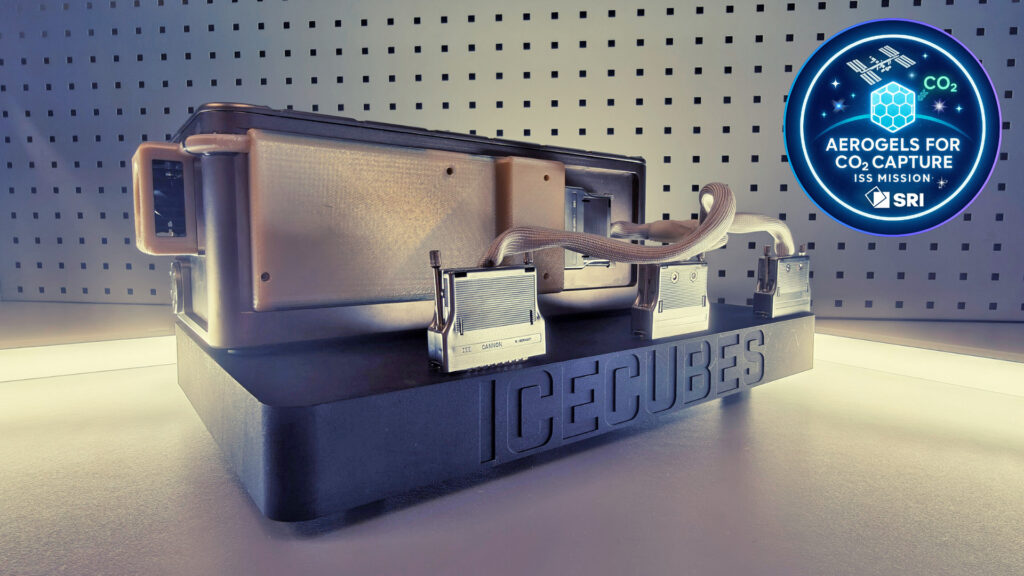
SRI’s aerogel experiment will travel to the International Space Station via NASA’s Northrop Grumman Commercial Resupply Services 24. Once the ICE Cube containing SRI’s experiment arrives at the ICE Cubes Facility aboard the ISS, an SRI scientist will remotely activate the synthesis of three different aerogels in microgravity. The samples are scheduled to return to Earth for analysis in June.
Why put aerogels in space?
SRI’s Microgravity Synthesis of Aerogel Copolymers project was selected as one of two winners of the ISS National Laboratory Sustainability Challenge: Beyond Plastics, put forth by the Center for the Advancement of Science in Space (which manages the ISS National Lab).
The goal is to advance carbon capture technology by learning more about aerogel formation in microgravity, explains SRI research scientist Koyel Bhattacharyya. Her team’s work has demonstrated that porous aerogels can play a demonstrable role in carbon capture, providing a new strategy to address climate change in the built environment. But we’re still optimizing aerogel manufacturing techniques. Growing aerogels on the International Space Station will give us new data on how these unique substances form in microgravity, which could potentially contribute to new approaches here on Earth as well.
“Knowing more about how gravity impacts the growth of these polymers is really important,” says Bhattacharyya. By understanding the effects of gravity on aerogel formation, the team aims to design better carbon capture materials on Earth that work more efficiently and cost less to deploy at scale.
While this project is focused on the carbon capturing properties of aerogels, she notes, there may be implications for other polymers as well. Given how essential polymers are to the global economy (think plastic bottles, polyester and nylon fabrics, and car tires), any data about how to manufacture them more efficiently and effectively can have important ripple effects.
Furthermore, she points out, the space community is already thinking about the moon as a critical waypoint on the journey to Mars. Which may well mean we want to manufacture materials there, where the gravity is one-sixth of Earth’s. “When we synthesize polymers on the moon, what will that look like?” she asks.
Bringing results back to Earth
SRI researchers have been working with Aerospace Applications North America to complete mission implementation and final integration into the ICE Cubes Facility (ICF). Once the cargo reaches the ISS, the ICF’s near-real-time ground interface will allow the MSAC team to monitor incoming data, images, and video and actively manage the experiment by sending commands to the payload, such as adjusting temperature and triggering specific steps. Currently, the mission team anticipates that the synthesized aerogel samples will return to Earth in late June aboard SpX-34. For SRI, that’s when the real work begins: evaluating the samples, comparing them to Earth-grown aerogels, and publishing research that begins to unpack the impact of gravity on these highly valuable substances.
Bhattacharyya expects the results to demonstrate important impacts on aerogel formation. “On Earth, gravity causes subtle fluid motion and settling as these materials form,” she explains. “This can disturb how the pores grow and connect, leading to less uniform internal structures.” In contrast, in the microgravity environment of the International Space Station, it’s likely that the material will form more evenly, potentially with a more consistent pore structure — which would further improve its efficacy for carbon capture.
“Opportunities to run experiments on the International Space Station are incredibly rare and coveted in the scientific community,” concludes Bhattacharyya. “It’s an honor to have our research selected for this trip into orbit.”
Learn more about SRI’s groundbreaking space research on space and polymeric aerogels or contact us.
Research reported in this publication was supported by the Center for the Advancement of Science in Space, Inc. and NASA under agreement number 80JSC018M0005. Any opinions, findings, and conclusions or recommendations expressed in this material are those of the author(s) and do not necessarily reflect the views of the National Aeronautics and Space Administration or the Center for the Advancement of Science in Space.