A new science teaching assistant, powered by AI
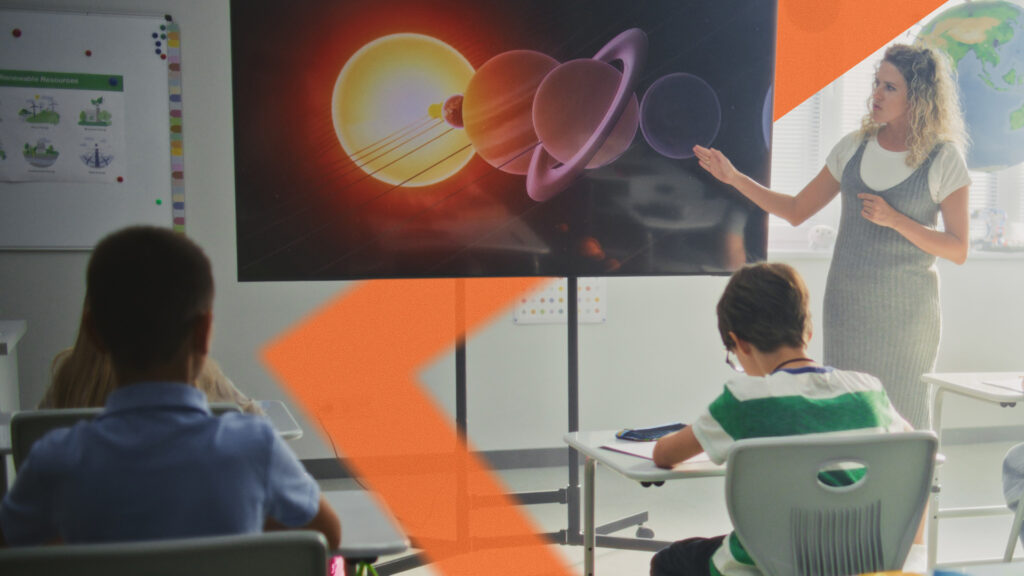
SRI’s LOVE Science project integrates education expertise, LLMs, and video to make science relevant and effective for students.
- Many teachers use video to explain science to elementary school students.
- By integrating AI, SRI’s LOVE Science platform helps teachers find relevant, high-quality science videos without spending hours searching.
Instructional videos have become a powerful tool for teaching science, particularly when explaining complex scientific topics to elementary school students. Platforms like YouTube contain a vast library of options. Education research shows that streaming video can promote student engagement and a deeper understanding of science.
The challenge: Finding the ideal YouTube video for a lesson is difficult and time-consuming for teachers.
“Teachers want to engage their students with multimedia,” says Nonye Alozie, co-lead of SRI’s STEM and Computer Science program area and a principal education researcher with SRI. “But tracking down science-based, standards-aligned, age-appropriate videos can take hours.”
To meet this challenge, Alozie and a team of SRI researchers launched LOVE Science (short for Leveraging Online Videos in Elementary Science), offering teachers an effective, AI-powered assistant to identify videos that bring science concepts to life. It’s one of the first projects to emerge from SRI’s Education Innovation Laboratory, a new initiative led by Alozie that accelerates the journey from education research to classroom impact.
AI: A powerful ally for busy teachers
LOVE Science is designed to help elementary teachers plan lessons and assessments using instructional videos that meet science standards and developmental needs, including the nationally recognized Next Generation Science Standards (NGSS).
To build the platform, the team collaborated with SRI’s Computer Science Lab (CSL), bringing in AI capabilities that complemented SRI education researchers deep understanding of curriculum standards instruction, assessments, and scaling strategies.
“Our colleagues brought skills like API orchestration and GenAI prompt engineering that have contributed incredible precision to our work and accelerated our ability to innovate,” comments Alozie.
LOVE Science brings together Google Gemini, YouTube’s video library, and an intuitive user interface to create a platform custom-made for busy teachers. The platform automatically screens and categorizes individual videos based on criteria such as grade level, topic domain, and alignment with science standards. It also allows teachers to search for new videos while providing summaries and analysis. Based on keywords, such as “states of matter” and “first grade,” the platform provides a list of standards-based, instruction-ready videos.
“LOVE Science isn’t about creating new content, it’s about transforming how teachers use what’s already there to help students build a deeper connection to science.” — Nonye Alozie, SRI Education
The team is now taking the next step: transforming the platform into an adaptive system that learns from teachers’ preferences.
“As teachers use the platform, it adapts,” said Alozie. “The goal is to offer a personal assistant that understands what each teacher needs. It’s about giving teachers time to focus on teaching, not searching.”
A more personalized future for education
In addition to saving time and connecting teachers with standards-aligned educational videos, SRI’s Center for the Future of Education and Technology director Leigh Ann DeLyser sees LOVE Science as an opportunity to help teachers cultivate their own personal approach to the material.
“What we’re seeing with AI is the opportunity to personalize content and texturize stories in ways that make sense for teachers,” says DeLyser. “They can quickly identify videos that complement their approach to the curriculum, the unit they’re in, and even what part of the country they’re in. Teaching science in Kansas looks really different from teaching science in New York City.”
With LOVE Science, teachers can quickly identify high-quality science content that’s uniquely relevant to their state or even their specific town.
“This is just the beginning,” says Alozie. “LOVE Science isn’t about creating new content, it’s about transforming how teachers use what’s already there to help students build a deeper connection to science.”
SRI is helping STEM and CS work for students and teachers
We’re advancing effective STEM and CS programs and systems across the education landscape.