SRI’s Computer Mouse and Telepresence Surgery recognized with IEEE Milestones
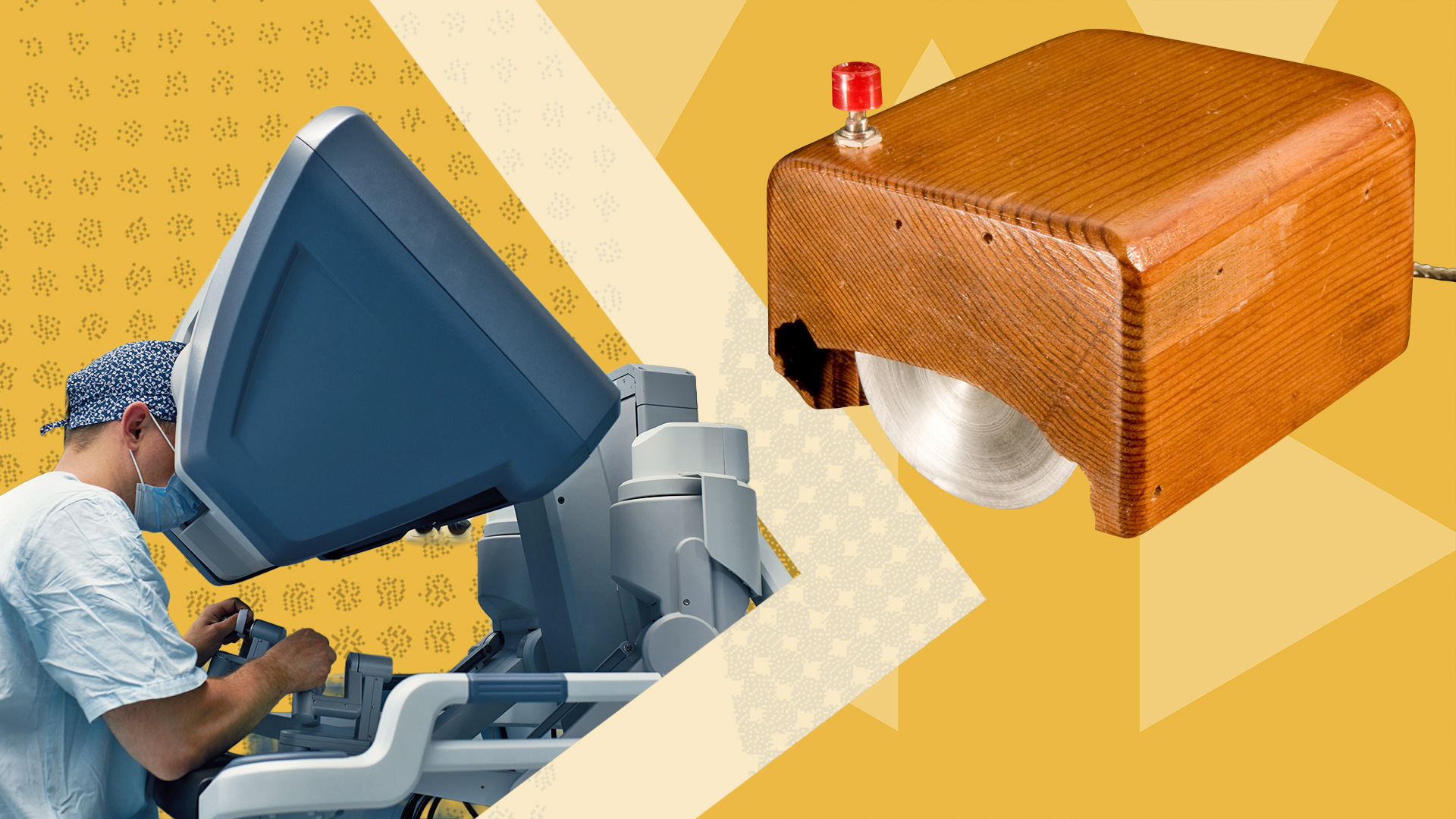
Plaques honoring the invention that opened computing to everyone, and the robotic system that became the da Vinci surgical robot, will be unveiled November 13 at the Computer History Museum.
IEEE, the world’s largest technical professional organization and a public charity dedicated to advancing technology for the benefit of humanity, has officially designated two SRI achievements as IEEE Milestones: Invention of SRI’s Computer Mouse, 1961–1968, and First Robotic Telepresence Surgery System, 1987–1995. The Milestones recognize innovations that changed how people work hand in hand with machines. One made computers usable by ordinary people, and the other let surgeons operate through keyhole incisions with greater precision than the human hand.
“Both ideas honored today began as experiments in SRI’s labs, years before anyone could imagine them being used in the real world,” said James Fritz, SVP of Strategic Development and Communications for SRI. “The mouse and telepresence surgery share a single conviction at the heart of SRI: technology should extend human ability, not replace it. We are proud to see that legacy recognized by IEEE.”
The bronze Milestone plaques will be unveiled during a dedication ceremony at the Computer History Museum in Mountain View, Calif., on November 13 from 9:30 to 11:30 a.m. PT. They will join SRI’s nine existing IEEE Milestones, including one honoring Shakey, the world’s first mobile intelligent robot, and another honoring Douglas Engelbart’s 1968 “Mother of All Demos.”
“Both ideas honored today began as experiments in SRI’s labs, years before anyone could imagine them being used in the real world.”
– James Fritz, SVP of Strategic Development and Communications for SRI
A wooden block that put computing in everyone’s hands
In 1961, at SRI’s Augmentation Research Center, Douglas Engelbart set out to make interactive computing both possible and efficient. That goal inspired the computer mouse. In 1963–1964, Engelbart and engineer Bill English created the first prototype: a small wooden block housing two perpendicular metal wheels that turned hand motion into electrical signals. SRI filed U.S. Patent 3,541,541, “X-Y Position Indicator for a Display System,” in 1967, and the mouse was a critical component of Engelbart’s landmark “Mother of All Demos” in San Francisco on December 9, 1968.
Before the mouse, using a computer meant mastering typed commands. The mouse went on to become the everyday tool that opened graphical computing to billions of people, and it helped give rise to the world of human-computer interaction we know today.
Operating without a surgeon’s hands on the patient
In 1987, an SRI team led by biomedical engineer Philip S. Green began developing the first surgeon-controlled robotic telepresence surgery system, designed to let surgeons operate on patients from a remote console. The system combined stereoscopic vision, motion scaling, and tremor filtering. The result was a telemanipulator that performed dexterous, minimally invasive procedures with greater precision than the human hand.
In 1995, SRI licensed the technology to Intuitive Surgical, an SRI spin-off, where it became the da Vinci Surgical System. In 2000, da Vinci became the first robotic system cleared by the FDA for general laparoscopic surgery. Today it supports complex operations, including cardiac surgery, through incisions as small as one to two centimeters.
Register here to attend the IEEE Milestone dedication event.