Case study: Making quantum magnetic field
sensing more portable and practical
SRI, working with collaborators at Twinleaf LLC and Princeton University on the DARPA
AMBIIENT program, led an effort that delivered a breakthrough in quantum sensing.
“Quantum technologies are poised to advance the state of art across diverse fields such as medical diagnostics, navigation, and computing. Our team’s work demonstrated magnetic field sensors based on applied quantum technologies that detect weak bio-magnetic signals in normal ambient environments, providing a path towards portable, practical magnetic sensing applications.”
Alan Braun, Associate Director of Applied Sciences,
Advanced Technology and Systems Division
CHALLENGE
Existing magnetic sensors lack the sensitivity and miniaturization needed for next-generation biomagnetic detection, proximity sensing, and anomaly detection in real-world environments. Biomagnetic research and diagnostic techniques like magnetoencephalography (MEG) and magnetocardiography (MCG), for example, continue to confront challenges toward widespread adoption due to the operational costs and implementation challenges of traditional systems. The most precise MEG machines have traditionally cost millions of dollars because they require cryogenically cooled magnetometers housed within advanced magnetically shielded rooms, which dampen unavoidable sources of noise such as environmental magnetic noise and stray ambient signals to isolate the signals of interest.
SOLUTION
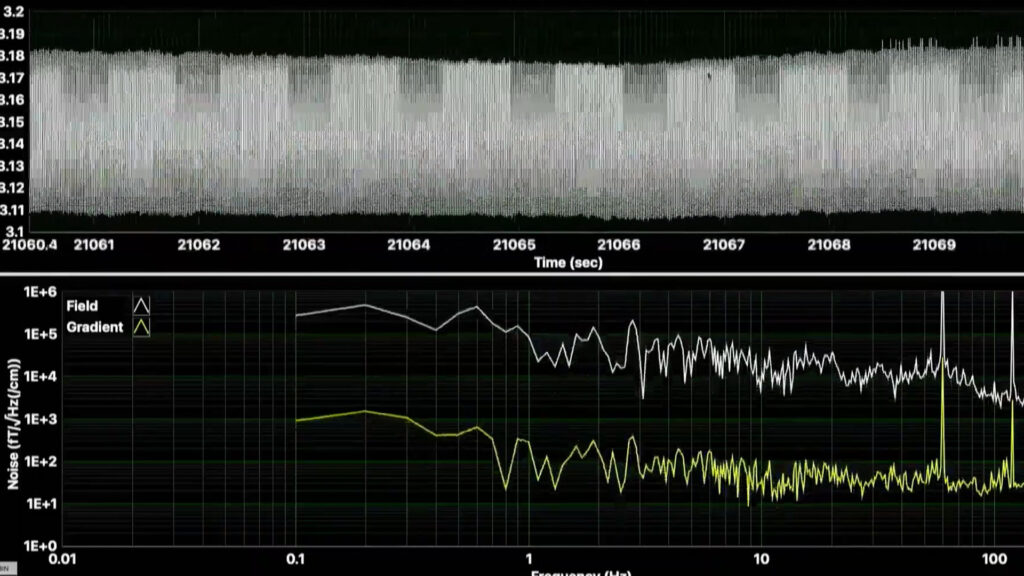
SRI researchers, working closely with collaborators Twinleaf LLC and Princeton University, led an effort to develop state-of-the-art magnetic field sensors by leveraging cutting-edge quantum technology. Working under the DARPA Atomic Magnetometer for Biological Imaging in Earth’s Native Terrain (AMBIIENT) program, the team delivered highly sensitive magnetic field sensors that operate unshielded in Earth’s native magnetic field. The sensors feature strong common-mode noise rejection that facilitates the detection of biomagnetic signals in unshielded environments. Based on optically pumped neutral-atom vapor-cell physics, these sensors are engineered with compact optical and vapor-cell packaging techniques, allowing for a compact footprint.
IMPACT
The research team successfully demonstrated high-sensitivity MCG and evoked-field MEG capabilities without shielded enclosures or cryogenics, paving the way for more portable and cost-effective biomagnetic sensing solutions. This work points toward new applications across numerous biomedical use cases, anomaly detection, and navigation in GPS-denied environments — with a clear path to field deployment.
OUR EXPERTS
-

Alan Braun
Associate Director, Applied Sciences, Advanced Technology and Systems Division