SRI International
-
Interpolative Decoding: Exploring the Spectrum of Personality Traits in LLMs
Abstract Recent research has explored using very large language models (LLMs) as proxies for humans in tasks such as simulation, surveys, and studies. While LLMs do not possess a human psychology, they often can emulate human behaviors with sufficiently high fidelity to drive simulations to test human behavioral hypotheses, exhibiting more nuance and range than…
-

Developing and Validating a Practitioner Toolkit to Scale and Sustain Collaborative Data Inquiry
This is the first impact study of Data Wise, which supports educators in using collaborative data inquiry to drive continuous improvement of teaching and learning.
-
Collaborative Innovations: Bridging Gaps and Promoting AI Literacy Through Engagement and Dissemination in Education
Abstract SRI researchers reviewed existing studies to understand how AI literacy is taught across grade levels and what components are emphasized in each grade band. Our findings show AI literacy can begin at a young age. This infographic shows the five key components of AI literacy emphasized in global K–12 research, and presents ways to…
-

The SRI Education Newsletter | Winter 2025
This newsletter includes a diverse range of new publications, web-based tools, and interactive resources designed to support practitioners, policymakers, funders, innovators, children, and families.
-

QED-C executive director named to the Quantum 100
Celia Merzbacher, executive director of the SRI-managed Quantum Economic Development Consortium, has been recognized for her role in strengthening the global quantum ecosystem.
-
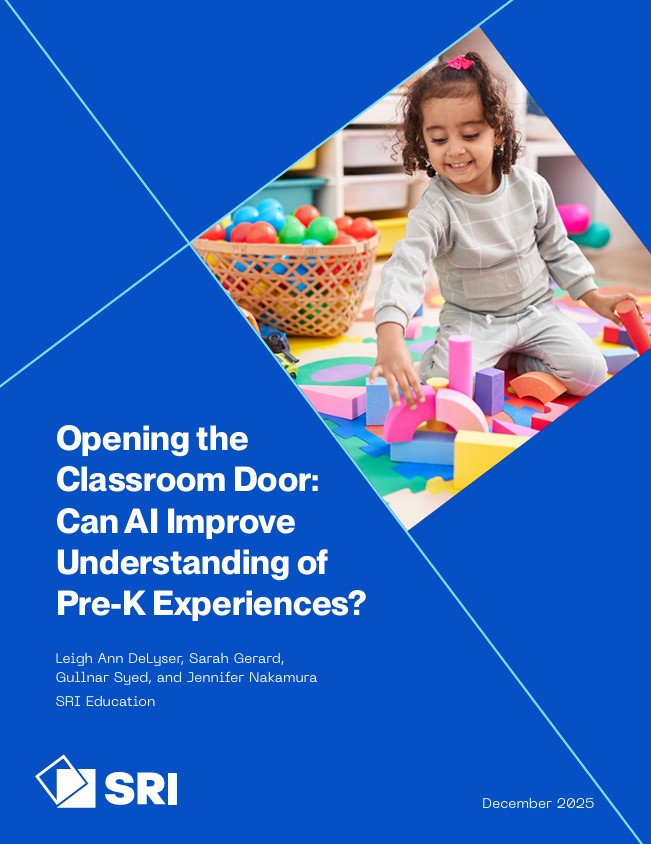
Opening the Classroom Door: Can AI Improve Understanding of Pre-K Experiences
This study explores the feasibility of AI models in identifying instructional groupings and academic content in pre-K classroom video recordings to understand classroom activities. The research team interviewed teachers, instructional coaches, and technology developers to understand their perceptions of artificial intelligence to support early learning. Findings highlight the promise and limitations of current AI approaches and…
-
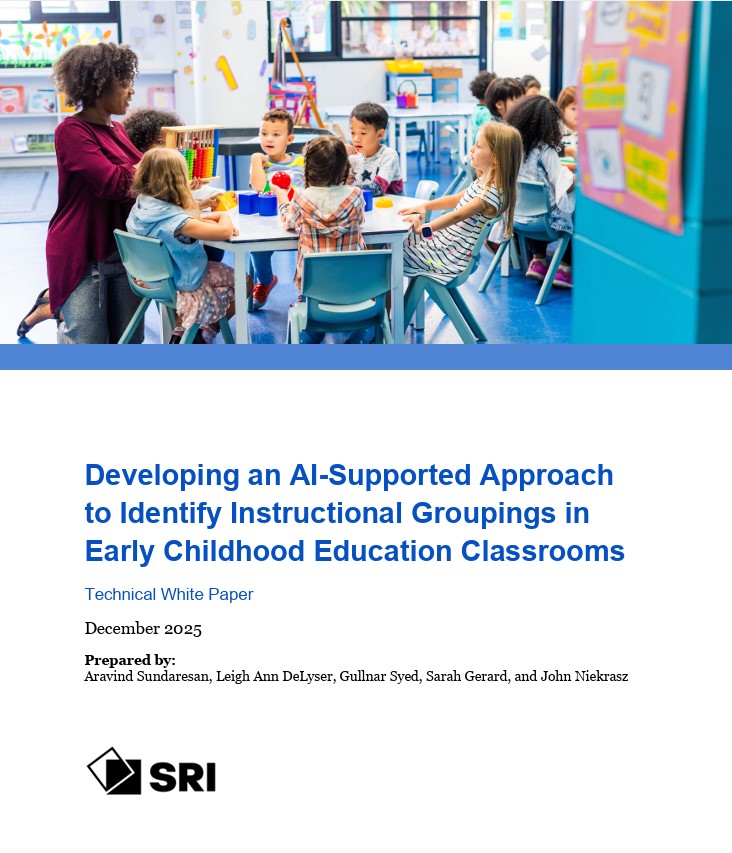
Developing an AI-Supported Approach to Identify Instructional Groupings in Early Childhood Education Classrooms
This technical white paper examines the feasibility of using AI-supported approaches to automatically identify instructional groupings (e.g., small group, whole group) in pre-K classroom video recordings. The research team developed a codebook, conducted human annotations and evaluated large language models using OpenAI’s GPT-4.1-mini and GPT-5 mini on the automatic identification task. Findings demonstrate promising early…
-
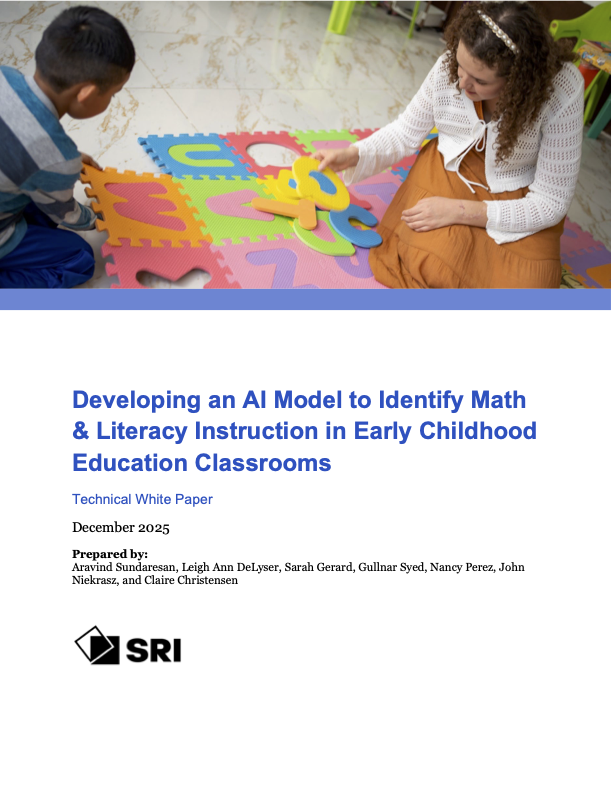
Developing an AI Model to Identify Math and Literacy Instruction in Early Childhood Education Classrooms
This technical white paper explores the feasibility of using AI and classroom video to automatically detect math and literacy instructional moments in pre-K settings. Building on SRI’s existing models, originally developed to identify academic content in YouTube video, this study applied a multimodal machine learning framework to pre-K classroom video recordings. Included are details on…
-

New engines of technology-driven growth
Leveraging proven lab-to-market expertise, SRI is helping collaborators from Japan to New Jersey strengthen their science and technology ecosystems.
-

Collaborative Innovations: Bridging Gaps and Promoting AI Literacy Through Engagement and Dissemination in Education (CIGALE)
SRI’s CIGALE project was designed to advance K–12 AI literacy by supporting educators, researchers, and practitioners in understanding and integrating AI into education.
-

Understanding Nebraska’s $55m Literacy Investment
SRI and the Nebraska Department of Education have partnered to evaluate Nebraska’s $55 million Comprehensive Literacy State Development grant, designed to strengthen literacy instruction from birth through grade 12.
-

Podcast: Designing and scaling the next generation of educational innovations
SRI’s Kerry Friedman and Adrienne Woods join Digital Promise’s Rebecca Griffiths to discuss new findings on the design and adoption of impactful products and programs.