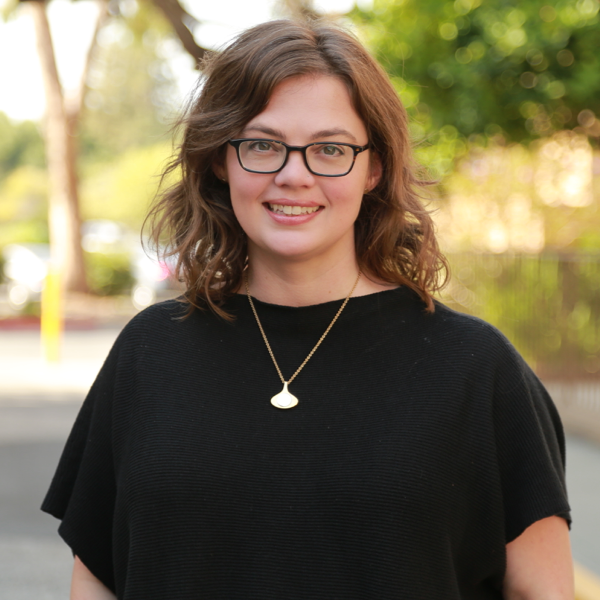
Education Researcher, SRI Education
Candice Benge Steele is a mixed-methods education researcher focused on helping public education systems become more equitable, responsive, and effective for all learners. She specializes in policy analysis, survey design, case study research, and data storytelling. Her research integrates qualitative and quantitative methods and is grounded in the belief that students thrive when they have access to well-supported teachers, engaging and relevant content, and meaningful opportunities for agency and voice.
Benge Steele brings a unique background in playwriting to her research practice, approaching data with a storytelling mindset that prioritizes empathy and accessibility. She contributes both project management and technical expertise to cohesive, actionable studies that help partners understand how systems are serving children—and how they can improve. Her recent projects include a landscape scan of arts education in California following new state investments; a study of a teacher residency program focused on building local educator pipelines; and an evaluation of a school reform initiative aimed at reimagining the high school experience. She also supports two multiyear initiatives: one that helps leaders build culturally and linguistically responsive school environments, and another that strengthens students’ sense of belonging and well-being in elementary schools.
Benge Steele is particularly interested in participatory and student-centered approaches to both research and education—exploring methods that elevate student voice as well as content areas like competency-based education and creative youth development. She is also excited about the potential for artificial intelligence to support teachers and students through hybrid learning models that enhance personalization, engagement, and efficiency.
Prior to joining SRI, Benge Steele worked with The Opportunity Institute, Education Trust – West, and First 5 Alameda County on education finance and stakeholder engagement, particularly in the context of California’s Local Control Funding Formula. She holds a Master of Public Affairs degree from the University of California, Berkeley; a Master of Liberal Arts degree from St. John’s College; a Bachelor of Arts degree from Southern Methodist University; and a certificate in education finance from Georgetown University.
Key projects
- Evaluation of the Alder Teaching Quality Partnership Teacher Residency Expansion
- District and School Uses of Federal Education Funds
- The Status of Arts Education in California
- Cost Analysis in Practice Project
- Barr Engage New England Evaluation
Recent publications
-
Leveraging Evidence to Procure Educational Products That Work: Strategies for School and District Leaders
In this brief, LEARN Network researchers share findings on what motivates decision-makers to procure products, who is involved in the decision-making process, and what sources of information they turn to…
-
California Arts Education Landscape 2025
Abstract Commissioned by the William and Flora Hewlett Foundation and conducted in collaboration with Education First, this report examines how new funding and policy shifts—especially the 2022 Arts and Music…
-
Building strong teacher residency programs: In support of sustaining a diverse, community-based teacher workforce
In this paper, we explore the characteristics of teacher residency partnerships, examining several examples between one IHE, the Alder Graduate School of Education (Alder), and LEAs in California.
-
Creativity Challenge: Arts Education in California’s Court and Community Schools
This study examines arts education access for students served by California’s district community day schools, county community schools, and juvenile court schools; which we collectively refer to as court and…
-
Creativity Challenge: The State of Arts Education in California – Full Report
Our goal was to assess schools’ arts programs relative to state goals, examine the systems of support for these programs, and identify ways in which state and local policymakers might…
-
Creativity Challenge: The State of Arts Education in California – Summary Report
We found that, while much remained the same in 2020 as in 2006, some aspects of arts education in California’s K–12 schools had improved.