SRI PARC Forum: Cyber resilience in space
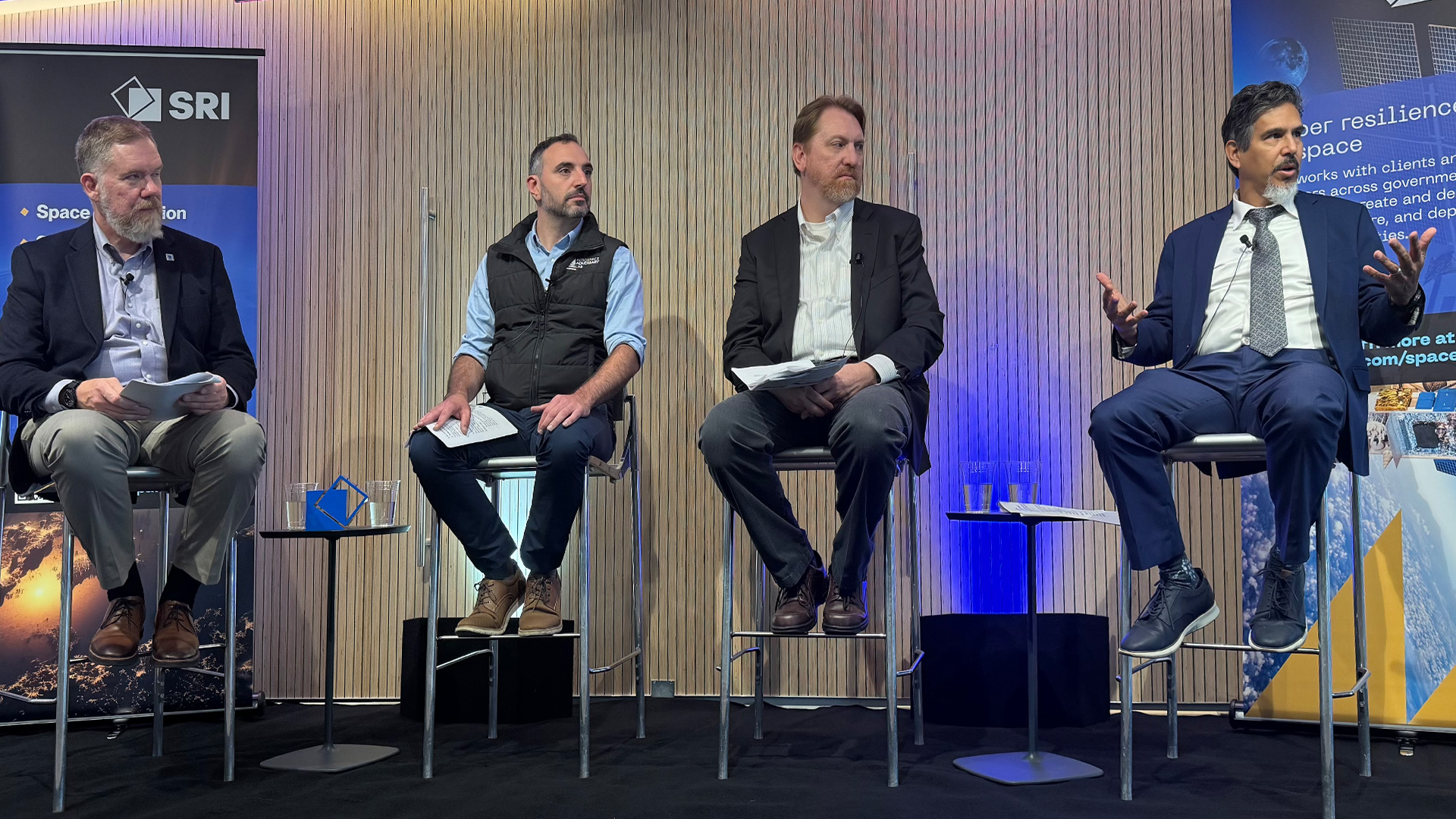
Space and cybersecurity experts point out that old security assumptions no longer hold as satellite networks grow in quantity and complexity.
This month’s PARC Forum, which took place in SRI’s Washington, DC office, was moderated by Ulf Lindqvist, Sr. Technical Director in SRI’s Computer Science Lab, and featured a panel of experts: Greg Falco (Cornell University, Aerospace Security & Autonomy Asst. Professor), James Curbo (Johns Hopkins Applied Physics Lab, Group Chief Scientist, Constrained Cyber Solutions Group), and Dan Trujillo (Air Force Research Lab, Space Warfare, Space Cyber Technical Leader). Watch the full PARC Forum discussion:
The Forum opened by pointing out that satellite counts have surged past 16,000 in the past five years, adding that amateur operators can track and even talk to orbiting assets. At the same time, spacecraft have grown more complex, becoming distributed, multi-vendor systems with a growing attack surface across organizations, components, and networks.
Panelists noted that space cybersecurity can’t just borrow from today’s IT security. Physics, legacy hardware, and the fact that you can’t just reboot a satellite present a much different problem. AI complicates the picture: it’s accelerating vulnerability discovery for attackers and defenders alike, which makes “assume breach” resilience more urgent than trying to prevent every intrusion.
The panel pointed to real progress — a newly released international standard for secure-by-design space systems — while acknowledging a persistent gap: too few engineers combine space with cybersecurity expertise. The discussion closed on two high notes: the Golden Dome missile defense program is a chance to bake in cyber resilience from day one rather than bolt it on later, and the coming shift to post-quantum encryption will demand real architectural changes.
SRI is advancing security & defense technologies
to address next-generation challenges in space
We deliver hardware, systems, and software that missions can rely on under the most challenging conditions.