SRI’s smart lidar imager joins DARPA’s ERIS Marketplace
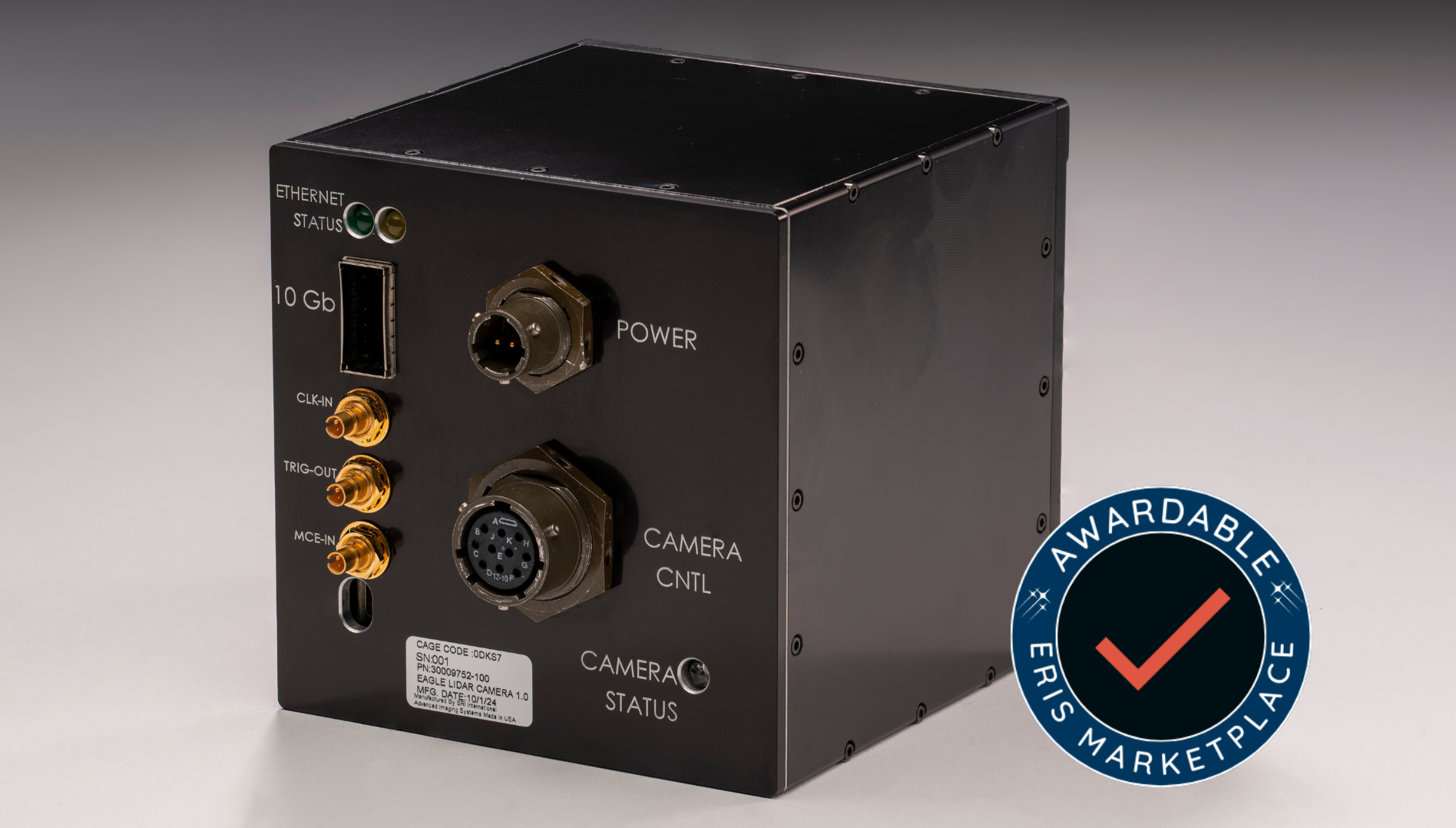
SRI’s low-power, dual-mode lidar imager is now available to government customers who need to see, range, and track objects in low light.
SRI’s dynamically biased Geiger-mode lidar imager is now part of DARPA’s Expedited Research Innovation System (ERIS) Marketplace, a transformative digital platform designed to accelerate acquisition velocity and advance national security innovation. The ERIS Marketplace empowers Department of War organizations to rapidly develop or acquire disruptive technologies that address the evolving challenges of defense and security. Each solution on the Marketplace has been competitively evaluated, so government customers can select, negotiate and award contracts more efficiently.
Seeing clearly in low light is still a hard problem for defense and security missions. Conventional Geiger-mode imagers built on 2D CMOS chips have low resolution and limited onboard computing, and they can only image actively. Those limits make them hard to scale.
SRI’s novel low power dynamically-biased Geiger mode Lidar imaging (GMLI) solution takes a different approach. Its dual-mode sensor measures range in low light, and built-in smart vision decides when to switch between lidar and imaging modes from the same sensor array so it can lock on to nearby objects and track them. The ROIC imager is split across three stacked chips: one senses the low light, one manages dynamic bias and quenching from avalanche breakdown, and the other handles smart sensing and control. The design is built for 3D heterogeneous integration (3DHI), an advanced chipmaking approach that packs more computing power into a smaller footprint.
“This dual-mode sensor design is scalable in size and offers high yield in fabrication,” said Dr. David Zhang, principal investigator on the project.
Bringing the tech together
The imager brings together expertise from across SRI, including readout circuit design for lidar, avalanche photodiode arrays, smart vision, and analog and digital chip design. SRI is also collaborating with Green Mountain Semiconductor on dynamic bias voltage design using non-silicon technology.
SRI’s video, “Dual-Mode Dynamically-Biased GmAPD Smart Vision Design in 3DHI,” describes the limitation of the state-of-the-art Lidar imagers, SRI’s rationale and ideas to address current GMLI challenges to DoW missions, 3DHI solutions in dual modes and smart visions for scalable design, and low light sensing and low power consumption. The video also shows examples of defense and civilian applications, and team capability. Government customers with a .mil email address can watch it on the ERIS Marketplace.
Learn more about SRI’s Center for Vision Technologies applications.
Visit the DARPA ERIS marketplace.