innovating in
Artificial Intelligence
Working across disciplines to deliver on AI’s promise
We’ve engaged in AI research for more than 50 years, creating and delivering world-changing advances like the first mobile robot with the ability to perceive and reason, commercial-quality speech recognition, and the Siri virtual personal assistant.
Today, AI technology — and the creation of new AI technology — are core to the research of many groups across SRI. Our researchers collaborate to build systems that sense, model, and learn to create ever more capable applications. Our approach is human-centered, emphasizing system transparency and explainability to address the critical issues of predictability and reliability of AI-based systems. Contact us to learn more.
Innovating in

“We work across disciplines and in close collaboration with our government and commercial customers to create new technologies, while strengthening the guardrails, so we can all truly benefit from AI’s extraordinary promise.”
Real-world impact
-

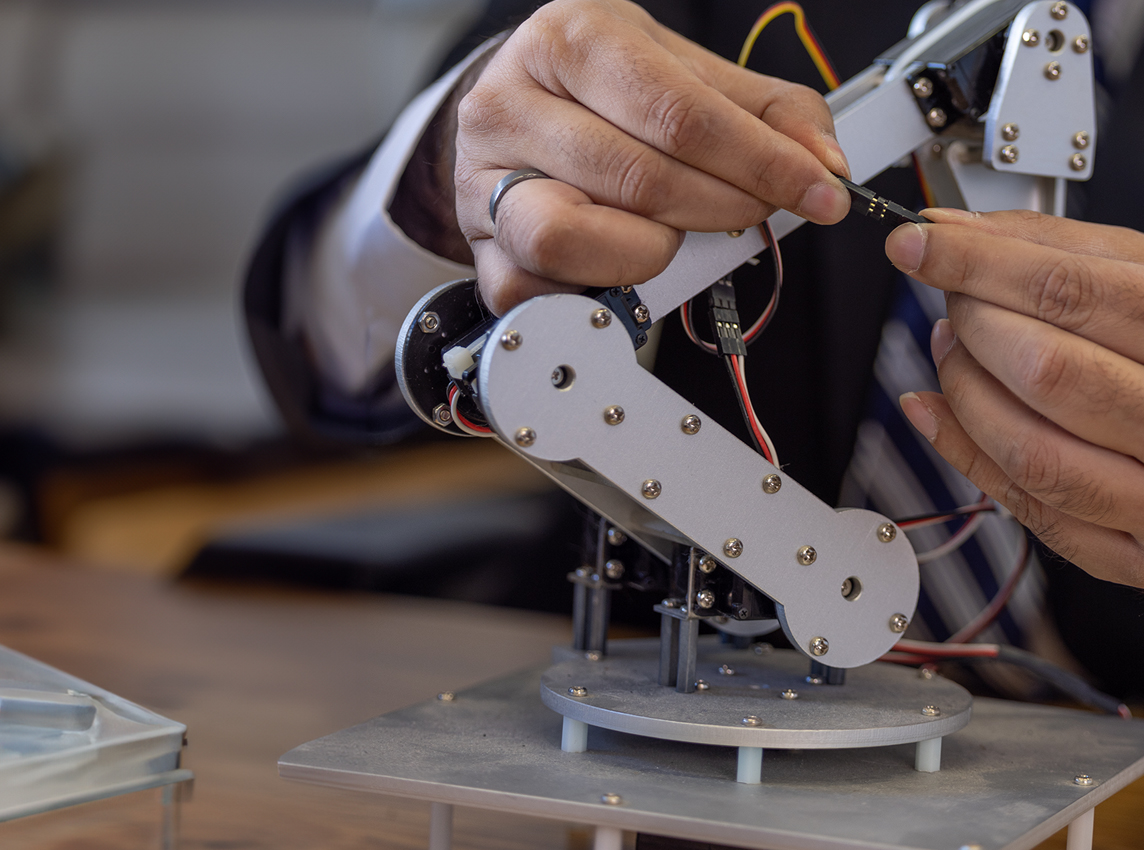
Pedro Sequeira: Bridging the gap between humans and machines
Working in SRI’s AI Center, Sequeira creates autonomous systems that learn, reason, and adapt under uncertainty.
-

Vaalia Health: Causal AI for precision healthcare
With healthcare shifting toward at-home solutions, Vaalia Health is building on SRI’s AI innovations to make sure that efficient care is also effective care.
-
Achieving the potential of autonomous drones
Leveraging SRI navigation technology, Entropy Robotics aims to create safe, resilient autonomous platforms for defense, livestock management, disaster recovery, and much more.
Core AI technologies and applications
Bioinformatics databases
BioCyc database collection
A comprehensive website for sharing fundamental information about biochemical pathways and genomes with researchers around the world
EcoCyc: encyclopedia of E. coli genes and metabolism
A bioinformatics database that describes the genome, metabolic network, and regulatory network of Escherichia coli
Recent publications
-
Building a Virtual Member of a Community of Practice
Abstract We describe a virtual member of a knowledge management Community of Practice (CoP), called ATHENA, that knows an individual, his tasks, his organization, and the community. ATHENA employs an agentic chat capability that combines embeddings with knowledge-based faceted search to provide accurate responses to technical questions along with rationale and citations for efficient validation.…
-
AI as Collaborative Partner: Rethinking Human-AI Teaming for the Real World
Abstract Much work in human-AI teaming today involves collaboration under fairly constrained settings. Humans supervise AI agents, who are relegated to following orders. The division of tasks is relatively superficial, with independent actions executed in parallel or with simple, linear dependencies between them. Communication is rigid and turn-based, with both parties speaking in complete, unambiguous…
-
ToMCAT: Theory-of-Mind for Cooperative Agents in Teams via Multiagent Diffusion Policies
We introduce ToMCAT, a framework that integrates Theory-of-Mind (ToM) reasoning with a multiagent diffusion model to generate team-aware plans conditioned on agents’ goals and inferred teammate characteristics. Experiments in a simulated domain demonstrate that agents with more ToM capabilities outperform ones without ToM and that ToMCAT’s dynamic replanning mechanism significantly improves resource efficiency while maintaining…