Spotlighting Douglas Engelbart’s invention of the computer mouse, Stanford Magazine revisits a moment when SRI transformed computing forever.
In this month’s issue of Stanford Magazine, the university highlights nine Stanford inventions that truly changed the world.
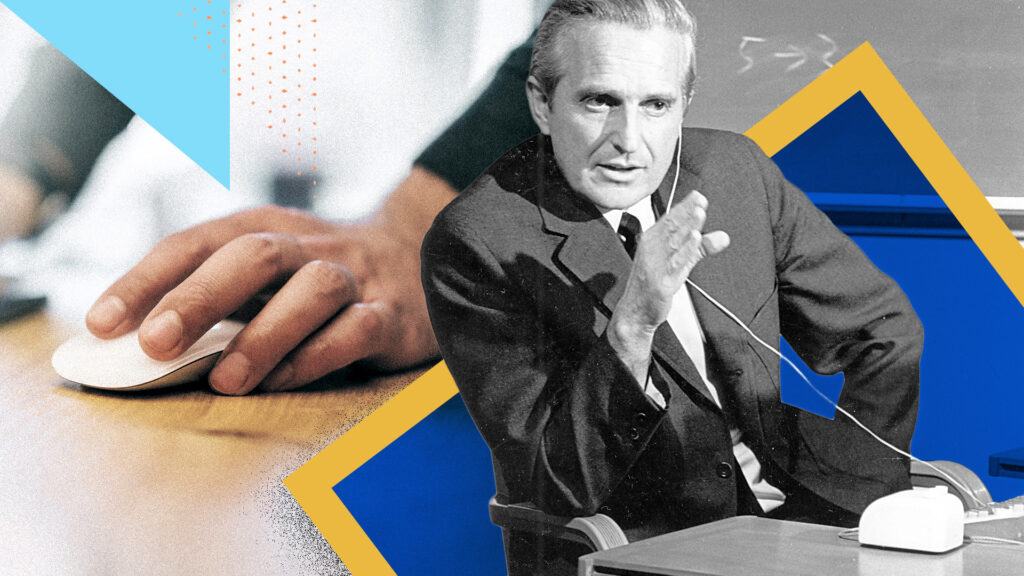
One of those highlighted innovations is the computer mouse, created by Douglas Engelbart at the Stanford Research Institute several years before the institute spun out of Stanford and became SRI.
As Stanford Magazine points out, when Engelbart introduced the computer mouse to the world as part of his 1968 “mother of all demos,” he also introduced hypertext linking, windows, and videoconferencing. This single demo marked the birth of modern personal computing.
“[W]e could have done a whole story on inventions that emerged from SRI while it was still part of the university.” — Kathy Zonana, Stanford Magazine
“Everything Engelbart demonstrated was later put into commercial — indeed everyday — use,” writes Rebecca Beyer in the magazine cover story. “The mouse made its mass-market debut in the mid-1980s at the behest of Apple’s Steve Jobs, who hired a Stanford-trained product design team to create a one-button version that could be manufactured for less than $35, paving a path that ultimately led to modern touch screens like the one in your pocket.”
In a column discussing Stanford Magazine’s selection process, editor Kathy Zonana points out that the computer mouse wasn’t the only groundbreaking technology to come out of SRI during its Stanford days.
“Incidentally, we could have done a whole story on inventions that emerged from SRI while it was still part of the university,” she writes. “Among them: the location of Disneyland — an analysis resulted in the recommendation of Anaheim, Calif. — and those squarish microencoded numbers on the bottom of checks, which revolutionized banking.”
She also notes that engineer William Fair and mathematician Earl Isaac were working together at the Stanford Research Institute (now SRI) when they co-founded Fair Isaac Corporation, which created the FICO score and laid the foundation for consumer credit scoring.
Since becoming independent from Stanford in 1970, SRI has continued to push the envelope of technological possibility. In the 1980s, as the manager of the Network Information Center, we defined and assigned the first website addresses. When we spun out Intuitive Surgical, we created an entire industry: robotic surgery. Our AI expertise launched Siri and brought virtual personal assistants into the hands of consumers around the world. And today, we’re building a future in which integrated circuits transmit information with light rather than electricity, where reliable and secure quantum systems deliver mind-bending sensing and computing capabilities, and where simple at-home cancer screening becomes a reality.
Learn more about SRI’s unparalleled history of innovation, including our nine IEEE Milestones.