SRI International
-
The Evidence Based Curriculum Design Framework: Leveraging Diverse Perspectives in the Design Process
This paper describes our approach to integrating the learning sciences with best practices in app design: a design framework that involves researchers and developers in a co-development process to create apps based on research and evidence.
-
The impact of career and technical education on students with disabilities
We use multiple years of administrative data from Massachusetts to estimate the effect of participating in CTE on the academic outcomes of students with disabilities.
-
Chicago’s Pay for Success Program Evaluation: Year 3
For each year of the program, SRI International, the program’s independent evaluator, releases a report of student performance across kindergarten readiness, special education utilization, and third-grade literacy.
-

SRI Education News & Notes | April 2018
In this issue, we highlight some of SRI’s recent work in disability research and evaluation.
-
Optical Calorimetry in Microfluidic Droplets
A novel microfluidic calorimeter that measures the enthalpy change of reactions occurring in 100 m diameter aqueous droplets in fluoropolymer oil has been developed.
-
Crowdsourcing Emotional Speech
We describe the methodology for the collection and annotation of a large corpus of emotional speech data through crowdsourcing.
-
Issue brief: Academic support classes
This brief on academic support classes is the twelfth in a series of briefs with key findings about these high school improvement strategies.
-
Artificial Intelligence: Lethal Autonomous Weapons Systems and Peace Time Threats
Abstract Panel Discussion: We are on the verge of one of the greatest paradigm shifts in human history. Research on Artificial Intelligence is enabling humanity to create autonomous intelligent software agents that can currently perform and learn new tasks without human guidance, observation or intervention, supplanting humans in decision making processes. This is already the…
-
SRI Education news | March 2018
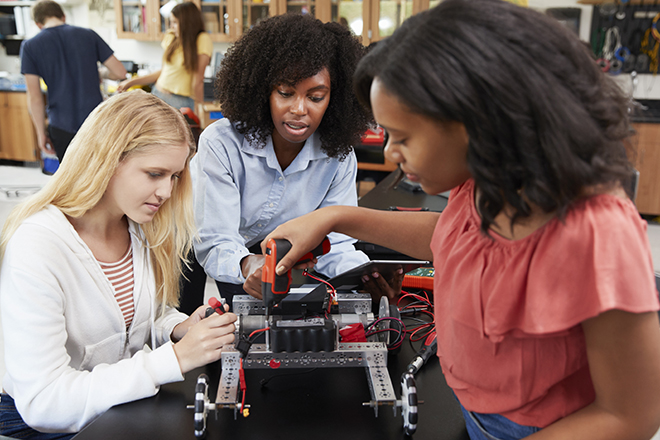
This month, we highlight our work in STEM teaching and learning, from family science learning to broadening participation in STEM through inclusive STEM high schools and mentored research experiences.
-
Flexible Hybrid Oral Biochemistry Sensing System
This talk will discuss PARCs work developing FHE fabrication processes, printed sensors, and demonstration systems.
-
Flexible Electronics and Oral Biosensing
This talk will discuss PARCs work developing FHE fabrication processes, printed sensors, and demonstration systems.
-
Augmented Reality Driving Using Semantic Geo-Registration
We propose a new approach that utilizes semantic information to register 2D monocular video frames to the world using 3D georeferenced data, for augmented reality driving applications.