SRI International
-

Evaluation of the Midwest Expansion of the Child-Parent Center Education Program
Funded by an Investing in Innovation (i3) validation grant from the U.S. Department of Education, SRI conducted an independent evaluation of the Midwest Expansion of the Child-Parent Center (CPC) Program using a quasi-experimental design.
-
Independent Evaluation of the Midwest CPC Expansion Project: Final Report
SRI conducted an independent evaluation of the Midwest Expansion of the Child-Parent Center (CPC) Program using a quasi-experimental design.
-
Hybrid Printed Sensors for Customizing the IOT
More recently, our team has been focusing on the integration of printed hybrid electronics with sensors and microchips.
-
Improvising Harmony: Opportunities for Technologies to Support Crowd Orchestration
This paper details the work of a seldom studied but growing population of members of grassroots, offline-project based groups.
-
Study of Experiences and Needs of Rural Education Achievement Program Grantees
This study’s objective was to examine state and district practices and perspectives regarding REAP, how districts use REAP funds and REAP-Flex, and states’ and districts’ recommendations for improving program operations.
-
College and career readiness: Course taking of deaf and hard of hearing secondary school students
The present study focused on DHH students’ college and career readiness by investigating their opportunities in secondary school to acquire college and career skills.
-
Printed Carbon Nanotube Gas Sensor Arrays for Natural Gas Leak Detection (invited)
With support from ARPA-E, PARC and NASA Ames Research Center are developing a low-cost, high-performance natural gas well leak detection system based on printed nanomaterials.
-
Verizon Innovative Learning Minority Male Program Case Study Brief
The Verizon Innovative Learning Minority Male Program (VIL MM) provides minority, male, middle school students with opportunities to engage in science, technology, engineering and mathematics (STEM) learning experiences in university settings.
-
Pharmacodynamic Assays to Facilitate Pre-clinical and Clinical Development of Pre-mRNA Splicing Modulatory Drug Candidates
We describe two types of novel pharmacodynamic assays that facilitate drug discovery and development of this intriguing class of innovative therapeutics; the first assay is useful for preclinical optimization of small-molecule agents that target the SF3B1 spliceosomal protein in animals, the second assay is an ex vivo validated, gel-based assay for the measurement of drug exposure…
-
Online mathematics homework increases student achievement
In a randomized field trial with seventh-grade mathematics students, we evaluated whether an educational technology intervention increased mathematics learning.
-

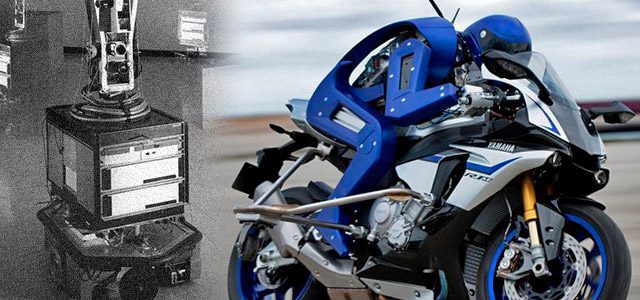
MOTOBOT
The first autonomous motorcycle-riding humanoid robot.
-
SRI: A Start-Up Celebrating its 70th Year
To those who see Silicon Valley as a cauldron of youthful creative talent leaping from start-up to start-up, finding one such start-up about to celebrate its 70th year might be surprising. One also might be curious how this longevity, centered in such a turbulent business environment, has occurred. While the real reasons are undoubtedly complex, having…