SRI International
-
Data handling in the smart grid: do we know enough?
We propose here a research agenda to appropriately balance the advantages of fine-grained energy usage data with the associated privacy risks.
-

Evidence Shows How the Right Use of Technology Can Increase Math Learning
SRI researchers published a series of studies that examine whether technology is effective and how it helps. Our findings show that technology can increase students’ understanding of math concepts, but only as part of a more comprehensive learning approach—one that also includes curricular content and teacher professional development.
-

SXSW: Sharing SRI’s Secrets to Successful Innovation
This past weekend, I had the pleasure of speaking at SXSW. My session on “commercialization secrets at SRI” was over-subscribed, with a few hundred attending, and many being turned away. This was a pleasant surprise, given the time of the talk was 9:30am on a Saturday morning! Anthony Ha of TechCrunch was a superb interviewer, and for…
-
Flexible, large-area sensor circuits fabricated by additive printing
Organic materials have been demonstrated as good candidates for large-area flexible sensors, because they allow wide tolerance of sensor geometry and thickness, which would ease fabrication problems such as strain induced cracking on deformable platforms.
-
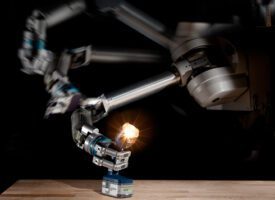
Growing the Bay Area Robotics Scene: Nine Companies to Watch
Silicon Valley Robotics (SVR) recently held its first Investor Breakfast at SRI headquarters in Menlo Park, with kudos from attending investors and the 10 participating early-stage companies. Part of SVR’s mission is to help nurture early-stage robotics companies in the greater Silicon Valley area. Both a growing list of start-up robotics companies in the Bay Area…
-
Cautionary Note: The Thermal Decomposition of Amino Acids in the Solid State
The Arrhenius parameters governing the pyrolysis rates for 19 amino acids in the solid state presented in the paper listed as reference 1 were developed in a dynamic TGA–DSC procedure employing single heating rate techniques and appear to be untrustworthy.
-
Crossing the Valley of Death: Transitioning Cybersecurity Research into Practice
This article presents an R&D execution model to increase the success rate of technology transition along with several examples of successful technology transition from the US Department of Homeland Security Science and Technology Directorate’s cybersecurity R&D program.
-
Ion Gyro-Harmonic Structuring in the Stimulated Radiation Spectrum and Optical Emissions During Electron Gyro-Harmonic Heating
The first extensive systematic experimental investigations of the possibility of these spectral features for third electron gyro-harmonic heating are provided here
-
Maximizing Availability of Content in Disruptive Environments by Cross-Layer Optimization
Inspired by delay- and disruption-tolerant networking, this paper presents a distributed cross-layer monitoring and optimization method for secure content delivery as a first step toward decentralized content-based mobile ad hoc networking.
-
Almorexant Promotes Sleep and Exacerbates Cataplexy in a Murine Model of Narcolepsy
The current study was designed to evaluate the hypnotic and cataplexy-inducing efficacy of a Hcrt antagonist in an animal model with low Hcrt tone and compare the ALM efficacy profile in the disease model to that produced in wild-type (WT) control animals.
-
Compound Ranking Based on a New Mathematical Measure of Effectiveness Using Time Course Data from Cell-Based Assays
This article proposes a new approach to measure drug effectiveness, which allows ranking compounds according to their toxic effects on live cells.
-
A “Conditional” Sense of Fairness in Assessment
This article builds on recent research in universal design for learning (UDL), assessment design, and psychometrics to lay out the rationale for inference that is conditional on matching examinees with principled variations of an assessment so as to reduce construct-irrelevant demands.