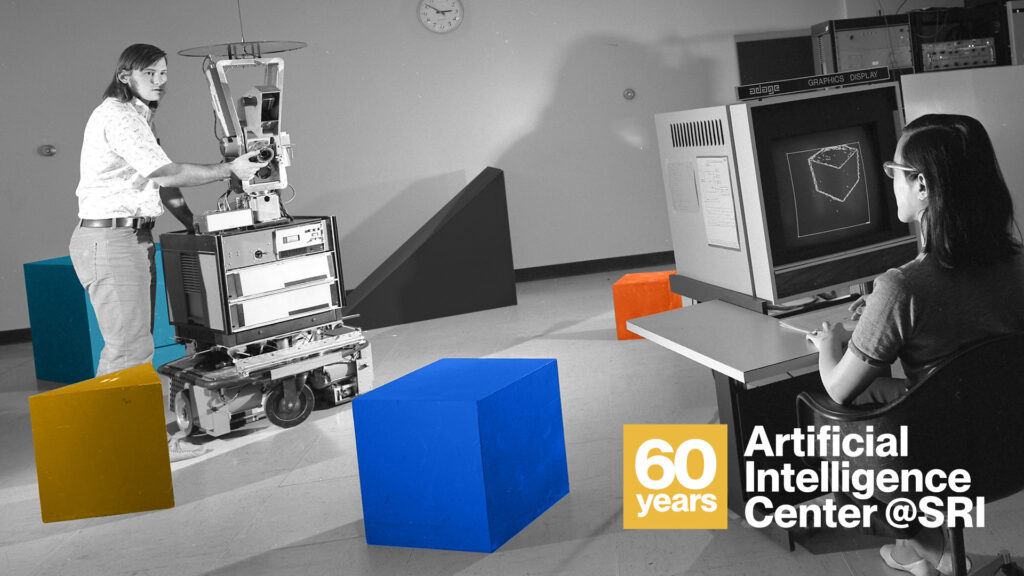
Created in 1966, SRI’s Artificial Intelligence Center was one of the world’s first research groups devoted to AI.
In 1966, a team at SRI set out to answer a groundbreaking question: Is it possible to build a computationally based system that can reason and act like a human? That was the beginning of SRI’s Artificial Intelligence Center, which this year marks 60 years of sustained AI contributions.
The AI Center’s first great experiment was Shakey the Robot, the world’s first physically embodied AI system. Built between 1966 and 1972, Shakey could perceive its environment through cameras, interact with humans via natural language, plan its activities, and take actions to achieve assigned goals. What made Shakey extraordinary was the integration of many capabilities — vision, navigation, logic, and planning — into one integrated, intelligent system.
The press took notice: In 1970, Life magazine called Shakey the “first electronic person,” and National Geographic featured it later that year. Shakey eventually earned a coveted IEEE Milestone and has a permanent home in the Computer History Museum.
“Fundamental research doesn’t make headlines the way product launches do, but it’s what makes those launches possible,” says Karen Myers, who has directed the AI Center since 2017. “SRI’s role has always been to work on ideas that are ahead of the market, and sixty years later, that hasn’t changed.”
Talking with machines: From the lab to our phones
Shakey led the AI Center’s researchers to another frontier problem: How do you talk to a robot? That question seeded decades of work in areas like natural language processing and agentic systems, leading in the early 2000s to the Cognitive Assistant that Learns and Organizes (CALO) project. Supported by DARPA’s Personalized Assistant that Learns program, CALO became a key component of what was, at the time, the largest AI project in U.S. history.
In 2007, SRI commercialized that technology to spin out a startup called Siri. Apple acquired the company in 2010 and first unveiled Siri as part of the iPhone 4S in 2011, putting SRI’s conversational AI research into hundreds of millions of pockets.
At the same time, the AI Center also built on the legacy of Shakey with breakthroughs like Centibots, a powerful demonstration of networked, autonomous robotics that profoundly influenced future robotics research.
The future of AI: LLMs and beyond
Today, the AI Center continues to push the cutting edge in areas that include human-AI collaboration, autonomous systems, and bioinformatics. The arrival of large language models (LLMs) brings a new capability that AI Center researchers are leveraging to turn autonomous agents into true teammates. A key part of that work is exploring how “theory of mind” can help AI systems understand human intentions.
The AI Center is breaking new ground in applying AI to physical infrastructure. The team is helping architects incorporate AI into building design. And emerging work in DARPA’s Rubble to Rockets program is combining neuro-symbolic AI and LLMs to improve the way engineering teams repurpose scavenged materials, including aluminum and plastics, to manufacture new hardware.
The center’s cross-disciplinary work with SRI’s Education division, meanwhile, is delivering new AI-powered tools designed to help schools and districts thoughtfully incorporate AI into the education system.
“Many problems remain,” Myers notes. “Making trustworthy and effective AI is one of the most important challenges we’re seeking to address.”
SRI is working to make AI more efficient, effective, and responsible.
SRI’s human-centered approach to AI emphasizes system transparency, explainability, reliability, and predictability.