
SRI examined how early care settings relate to whether young children with developmental concerns are identified and receive services, finding that these pathways depend on family and social context.
Early childhood is a critical period for identifying developmental challenges and connecting children and families to supports that promote healthy development. Child care and early education programs are often the settings where developmental concerns are first noticed and where children may be screened or referred for evaluation. Yet families’ access to formal early care – either home-based or center-based care – and to supports and services to support child development may vary across communities and circumstances.
Understanding how early care settings shape whether developmental concerns are identified and addressed is essential for building more inclusive and effective early childhood systems.
The team, including Adrienne Woods, Ginger Elliott-Teague, and Gullnar Syed, focused on children showing signs of developmental concerns and examined the types of child care and early education they experienced – such as informal, home-based, and center-based contexts.
They also studied whether children were identified for developmental concerns or received services, and how early education and child care arrangements were related to children’s later outcomes. Using quasi‑experimental and regression methods, the team compared children with similar developmental profiles and family characteristics to better understand how care settings, family context, and development are linked to identification and support.
Key Takeaway:
Early care settings do not directly determine whether children are identified for developmental concerns. Instead, they shape how family and social factors influence whether children’s needs are recognized and supported.
Their findings are presented in a public report and supporting dissemination materials designed to inform ACF, early childhood leaders, and individuals with IDEA child‑find and service systems.
Our work
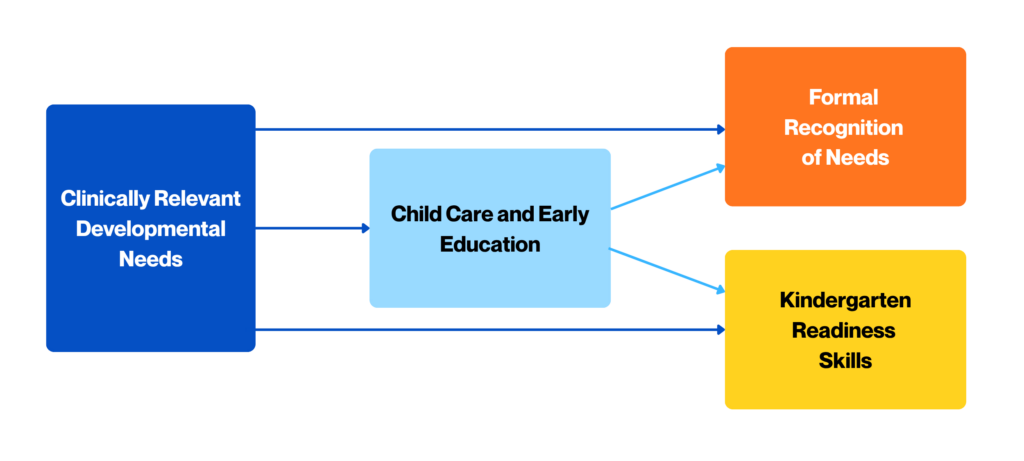
SRI examined how children with clinically relevant developmental needs, such as children with scores more than one standard deviation below the mean on normed assessments, participate in different types of child care and early education, and how those experiences relate to formal recognition, services, and support for developmental concerns. The team also explored how early education and care settings may function as developmental “detection contexts,” shaping how families’ socioeconomic resources translate into recognition and support for developmental concerns.
The team compared children’s experiences across informal care – primarily parent or relative care – home-based, non-parental care, and center-based care, including part-time and full-time participation. Their analyses incorporated children’ developmental profiles, household and caregiver characteristics, and other indicators of socioeconomic context, and employed rigorous quantitative methods, including quasi-experimental and statistical modeling approaches, to examine patterns of enrollment, recognition, and outcomes.
Key insights
- Participation in child care and early education is socially stratified.
Children did not enroll in early care settings randomly. Those from higher socioeconomic backgrounds were more likely to attend formal care, while others were more likely to rely on informal care. These differences increased from infancy to preschool.
- Developmental needs matter – but not equally for all children.
Children with stronger signs of developmental delay were more likely to be identified or receive services. However, identification also varied across family and social characteristics, meaning children with similar developmental profiles did not always receive the same level of recognition or support.
- Early care settings shape pathways to identification.
We did not find consistent evidence that a specific type of care (such as center-based care) directly increased the likelihood that children were identified. Instead, early care settings influenced how family resources were connected to identification. Specifically, children in home-based non-parental care settings were less likely to be identified when their families had fewer socioeconomic resources.
- Children’s prior development and family environment were the strongest predictors of kindergarten outcomes.
Participation in center-based care at age 4 was associated with higher language skills, but most differences across care types were explained by earlier development and family interactions like shared reading and caregiver engagement.
Potential applications
These findings suggest that improving early identification is not only about expanding access to specific types of care. It also requires strengthening how developmental concerns are recognized and acted upon across all care settings. This work highlights several opportunities for federal and state leaders, early childhood program administrators, and IDEA child‑find and service systems to identify where and for whom barriers to timely identification of developmental concerns and coordination of related
supports or services may occur. Opportunities include:
- Improving screening and referral practices in home-based and informal care settings
- Strengthening connections between early care providers and early intervention systems
- Supporting families in navigating evaluation and service systems.
Together, these steps can help ensure that children with developmental concerns are identified and supported earlier, regardless of where they receive care.
Associated SRI team members
-

Adrienne Woods
Senior Education Researcher, SRI Education
-

Ginger Elliott-Teague
Ginger Elliott-Teague, Senior Education Researcher, SRI Education
-

Gullnar Syed
Gullnar Syed, Education Researcher, SRI Education
This project was supported by the Administration for Children and Families (ACF) of the United States (U.S.) Department of Health and Human Services (HHS) as part of a financial assistance award (Award #: 90YE0335-01-00) totaling $99,754 with 100 percent funded by ACF/HHS. The contents are those of the author(s) and do not necessarily represent the official views of, nor an endorsement, by ACF/HHS, or the U.S. Government. For more information, please visit the ACF website.