Press
-

Now Airports and Travelers Can Have Both Security and Convenience
The airline industry is undergoing tremendous changes. Higher capacity airplanes are being built, flights along major routes are increasing, and airports are expanding to meet growing travel demands. The International Air Transport Association (IATA), projects that global travel will grow 4.1 percent per year over the next 20 years, from 3.3 billion passengers in 2014…
-
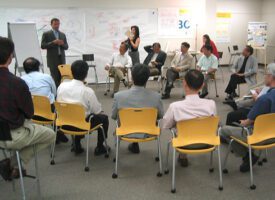
What Makes Silicon Valley Work?
A recent San Jose Mercury News article looked at innovation in Silicon Valley and what makes it tick like no other technology hotbed. Researchers at the Massachusetts Institute of Technology (MIT) and the National Bureau of Economic Research built a map pinpointing the location of successful start-ups based on criteria such as IPO or acquisition and the factors…
-
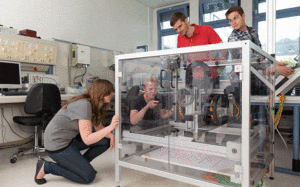
Evidence Shows Continued Promise for California High School Students in Linked Learning Pathways
As Linked Learning—an innovative high school approach that integrates rigorous academics with real-world experiences—continues to gain momentum among educators and policymakers across the state, SRI Education’s Center for Education Policy has released its fifth annual evaluation report on the progress of the California Linked Learning District Initiative. Whereas previous reports focused on the development and implementation of systems within…
-
Investigators Chart New Frontiers at Cyberlearning 2015
A group of more than 150 research-based leaders in learning and technology participated in Cyberlearning 2015 …
-

Raising the Quality Bar on Sequenced Genomes with Metabolic Modeling
Sequencing an organism’s genome is an important step in understanding how an organism functions. It elucidates the set of genes present in that organism, but genome annotation—the identification of genes within the DNA sequence and the assignment of functions to those genes—is an inexact science. Some genes receive incorrect functional assignments, functions for many genes…
-
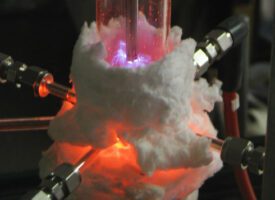
Advances in Materials Science Move Energy Innovation
While advances in energy efficiency, electric cars and renewable energy make the news, the big story is how advances in materials science make it all possible. New classes of materials, plus innovations in manufacture and use, have already helped cars and planes use less fuel; produced batteries that are smaller, lighter, and run longer; and…
-

Why the Cyber Security Industry Should Be Smitten with Smten
Keeping pace with today’s evolving cyber threats is challenged not only by hackers’ sophistication, but also by the mind-boggling volume of attacks.
-

Iris Biometrics Goes Mainstream
The new IOM PassPort™ SL walk-through system was developed for high-throughput identity authentication in active environments such as airports.
-

Curation Tells Researchers the Stories of Metabolic Pathways in the Biochemical Factories of Life
SRI’s MetaCyc (“metabolic encyclopedia”) database is a huge collection of metabolic pathways and enzyme descriptions from all domains of life.
-
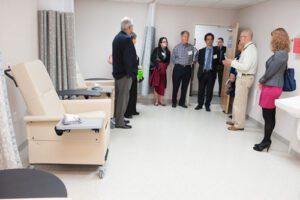
Medical Innovation Expands with State-of-the-Art Phase 1 Clinical Trial Facility at Michigan Life Science and Innovation Center
This blog post originally appeared on the Michigan Economic Development Corporation blog. Last month, SRI International launched a new, state-of-the-art, Phase 1 clinical trial facility in the Michigan Life Science and Innovation Center (MLSIC) in Plymouth. We’re thrilled for this new facility to bring even more medical innovation to Michigan; the fully-equipped, 13-bed facility will help emerging…
-
SRI’s Professional Development Program Helps Math Teachers Improvise and Learn Argumentation Skills
As the Common Core State Standards are being rolled out nationwide, mathematical argumentation—the line of reasoning that shows or explains why a mathematical result is true—has become an important skill for math teachers and students alike. To teach argumentation skills to teachers and bridge the gap between professional development (PD) and classroom practice, SRI Education’s Center…
-
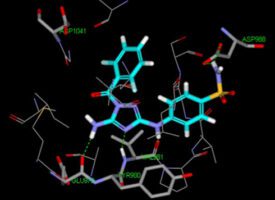
Promising Step in Psoriasis Drug Development: Small Molecules That Fight Inflammatory and Autoimmune Diseases
Recently, researchers in SRI Biosciences’ Center for Immunology and Infectious Diseases, in collaboration with colleagues at UK-based Sareum Ltd., a drug discovery company, identified a small molecule that looks like a promising therapy for psoriasis, an autoimmune disease of the skin affecting approximately two percent of the population. Symptoms of the condition often include painful, itching…