SRI International
-
Analyzing hyperspectral images into multiple subspaces using Guassian mixture models
I argue that the spectra in a hyperspectral datacube will usually lie in several low dimensional subspaces, and that these subspaces are more easily estimated from the data than the endmembers
-
Trust in Content-Centric Networking: From Theory to Practice
We present the logical design of a trust engine for Information-Centric Networking (ICN) that is capable of efficiently and correctly verifying content integrity and authenticity.
-
Feature Derivation for Exploitation of Distant Annotation via Pattern Induction against Dependency Parses
We consider the use of distant supervision for biological information extraction, and introduce two understudied corpora of this form, the Biological Expression Language (BEL) Large Corpus and the Pathway Logic (PL) Datum Corpus.
-
Evaluation of World Bicycle Relief’s Bicycles for Educational Empowerment Program: South Africa Opportunity Study
The purpose of this “opportunity study” was to identify the opportunity that bicycles could offer to rural South African schoolchildren; the critical factors that support and hinder implementation; and suggestions for program improvement.
-
Case studies of the early implementation of Kindergarten Entry Assessments
This report presents findings from a descriptive study that examined the development and early implementation of Kindergarten Entry Assessments (KEAs) in 12 districts across four Race To the Top-Early Learning Challenge grantee states.
-
Improving early literacy in PreK–3: Lessons learned (August 2016)
The Pathway Schools Initiative aims to dramatically increase the number of students who reach the critical milestone of grade 3 reading proficiency, an indicator predictive of later academic outcomes and high school graduation.
-
Evaluation of Rocketship Students’ Middle School Outcomes
Rocketship Education is a 501(c)(3) nonprofit corporation whose mission is to eliminate the achievement gap by building a scalable and sustainable school model that propels student achievement in underserved communities across the country.
-

Collaboration is Key to Tackling Emerging Infectious Diseases
As the news headlines tell us daily, emerging and re-emerging infectious diseases are a growing threat. Viruses such as Zika, Middle Eastern Respiratory Syndrome (MERS) and yellow fever are causing illness and significant concern around the globe. There are many causes for the emergence and spread of these diseases: commercial air travel (which provides fast…
-
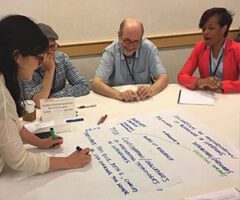
Cyberlearning ‘16 Tackles Designs for Deeper, Broader, and More Equitable Learning
The 5th annual Cyberlearning meeting, recently held in Arlington, VA, engaged more than 180 NSF-funded researchers, educators and other attendees,
-
Matrix factorization-based clustering of image features for bandwidth-constrained information retrieval
We consider the problem of accurately and efficiently querying a remote server to retrieve information about images captured by a mobile device.
-
Challenges in Formulating Explanatory Models for Co-morbidities
Abstract Patients with multiple health conditions pose significant challenges for modern healthcare. Understanding if and how these conditions are linked is essential to providing effective treatment. Physicians and researchers create explanatory models to develop hypotheses for these connections. In this paper, we discuss the breadth of domains these explanations draw upon as well as the…
-

Young Universities as Engines of Innovation
Universities the world over face pressure to contribute to the innovation-based economic development of the regions and nations that host them. This pressure is particularly acute for new universities – those established within the last few decades. Virtually all of these young schools were founded with the express purpose of accelerating local innovation. At the…