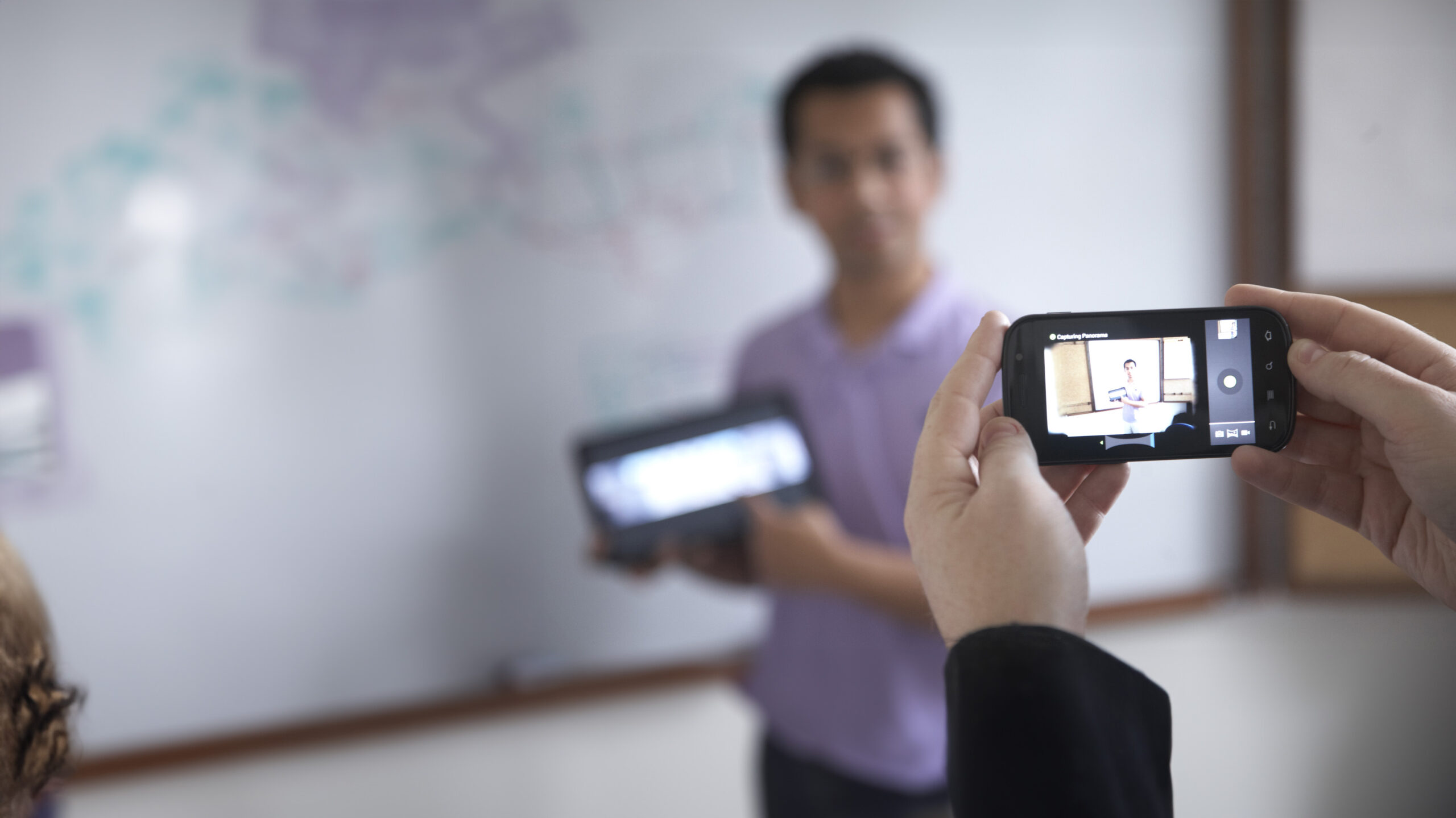
Center for vision technologies
Fundamental computer vision solutions based on leading-edge technologies, leveraging a variety of sensors and computation platforms
The Center for Vision Technologies does both early-stage research and developmental work to build prototype solutions that impact government and commercial markets, including defense, healthcare, automotive and more. Numerous companies have been spun-off from CVT technology successes.
The Center for Vision Technologies (CVT) develops and applies its algorithms and hardware to be able to see better with computational sensing, understand the scene using 2D/3D reasoning, understand and interact with humans using interactive intelligent systems, support teamwork through collaborative autonomy, mine big data with multi-modal data analytics and continuously learn through machine learning.
Recent developments from CVT include core machine learning algorithms in various areas such as learning with fewer labels, predictive machine learning for handling surprise and novel situations, lifelong learning, reinforcement learning using semantics and robust/explainable artificial intelligence.
SmartVision imaging systems use semantic processing/multi-modal sensing and embedded low-power processing for machine learning to automatically adapt and capture good quality imagery and information streams in challenging and degraded visual environments.
Multi-sensor navigation systems are used for wide-area augmented reality and provide GPS-denied localization for humans and mobile platforms operating in air, ground, naval, and subterranean environments. CVT has extended its navigation and 3D modeling work to include semantic reasoning, making it more robust to changes in the scene. Collaborative autonomy systems can use semantic reasoning, enabling platforms to efficiently exchange dynamic scene information with each other and allow a single user to control many robotic platforms using high-level directives.
Human behavior understanding is used to assess human state and emotions (e.g., in the Toyota 2020 concept car) and to build full-body, multi-modal (speech, gesture, gaze, etc.) human-computer interaction systems.
Multi-modal data analytics systems are used for fine-grain object recognition, activity, and change detection and search in cluttered environments.
Our work
-

SRI’s Industrial Vision technology for facility management
SRI’s AI-powered vision system serves as a digital bridge, transforming today’s legacy solution into modern enterprise intelligence.
-

SRI addresses the rural healthcare gap with AI innovation
SRI researchers are building an AI-driven system designed to upskill clinicians and transform rural healthcare delivery.
-

Designing better human-machine teams
SRI is discovering how AI can organize humans and machines into complex, collaborative, high-functioning units.
Core technologies and applications
SRI’s Center for Vision Technologies (CVT) tackles data acquisition and exploitation challenges across a broad range of applications and industries. Our researchers work in cross-disciplinary teams, including robotics and artificial intelligence, to advance, combine and customize technologies in areas including computational sensing, 2D-3D reasoning, collaborative autonomy, human behavior modeling, vision analytics, and machine learning.
Publications by research area
Computational sensing and low-power processing
-
Low-Power In-Pixel Computing with Current-Modulated Switched Capacitors
We present a scalable in-pixel processing architecture that can reduce the data throughput by 10X and consume less than 30 mW per megapixel at the imager frontend.
2d 3d reasoning and augmented reality
-
GeoSURGE: Geo-localization using semantic fusion with hierarchy of geographic embeddings
Abstract Worldwide visual geo-localization aims to determine the geographic location of an image anywhere on Earth using only its visual content. Despite recent progress, learning expressive representations of geographic space…
Collaborative human-robot autonomy
-
Concepts for autonomous navigation of underground mine face haulage equipment using depth cameras
Abstract This paper describes the development of a software pipeline for autonomous navigation of underground mine haulage equipment. The approach uses depth-sensing cameras mounted on the haulage vehicle to capture visual and depth information. Semantic segmentation is used to identify various objects in the scene, e.g., roof, ribs, floor, people, and mining equipment, and the…
Human behavior modeling
-
Towards Understanding Confusion and Affective States Under Communication Failures in Voice-Based Human-Machine Interaction
We present a series of two studies conducted to understand user’s affective states during voice-based human-machine interactions.
Multi-modal data analytics
-
Time-Space Processing for Small Ship Detection in SAR
This paper presents a new 3D time-space detector for small ships in single look complex (SLC) synthetic aperture radar (SAR) imagery, optimized for small targets around 5-15 m long that…
Machine learning
-
DUDA: Distilled unsupervised domain adaptation for lightweight semantic segmentation
Abstract Unsupervised Domain Adaptation (UDA) is essential for enabling semantic segmentation in new domains without requiring costly pixel-wise annotations. State-of-the-art (SOTA) UDA methods primarily use self-training with architecturally identical teacher…
Publications
-
Concepts for autonomous navigation of underground mine face haulage equipment using depth cameras
Abstract This paper describes the development of a software pipeline for autonomous navigation of underground mine haulage equipment. The approach uses depth-sensing cameras mounted on the haulage vehicle to capture…
-
Medical Procedure Tracking using Abductive Planning – A PARADIGM Shift
Abstract This paper presents PARACHUTE, a Prolog-based frame-work for abductive trace completion and projection for real-time medical procedure tracking and guidance, developed as part of the AI-powered AMIRA system in…
-
GeoSURGE: Geo-localization using semantic fusion with hierarchy of geographic embeddings
Abstract Worldwide visual geo-localization aims to determine the geographic location of an image anywhere on Earth using only its visual content. Despite recent progress, learning expressive representations of geographic space…
Computer vision leadership
-

William Mark
Senior Technology Advisor, Commercialization
-

Rakesh “Teddy” Kumar
Vice President, Information and Computing Sciences and Director, Center for Vision Technologies
Our team
-
Rakesh “Teddy” Kumar
Vice President, Information and Computing Sciences and Director, Center for Vision Technologies
-

Supun Samarasekera
Senior Technical Director, Vision and Robotics Laboratory, Center for Vision Technologies
-

Michael Piacentino
Senior Technical Director, Vision Systems Laboratory, Center for Vision Technologies
-

Han-Pang Chiu
Technical Director, Vision and Robotics Laboratory, Center for Vision Technologies
-

Bogdan Matei
Technical Director, Vision and Robotics Laboratory, Center for Vision Technologies